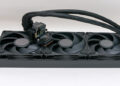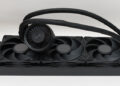
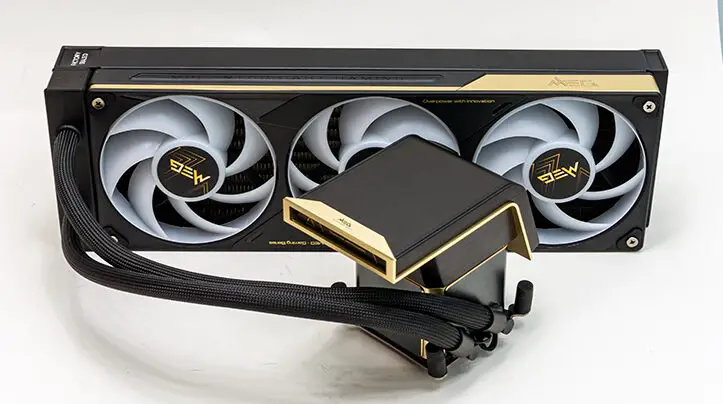

Even on just a quick glance, one can tell this is not your average, everyday All In One Cooling solution. The gold accents, the downright bespoke fan configuration, the alloy accents on the block… and yes, that pretty wrap-around screen all combine into a package that is beyond best in class.. and rather creates an entirely new class above best in class. A class that is obviously intended for open-concept builds… that cost more than a used car.
Bluntly stated, this is a very attractive piece of kit… and we are a bit surprised that we actually like it. For us, usually gold “gold” is synonymous with “gaudy” and/or “gamer gauche”. To be fair, MSI MPG Gold is one of the few exceptions to our rule of thumb, and once again (somehow) MSI were able to walk right up to that line that separates attractiveness from over-processed without stepping over. So while the E15 360 and its gold accents certainly make it highly distinctive-looking, we never once even thought “elevator in an outhouse,” let alone “who thought that was a good idea?!”.

With that said, you have to be willing to have an aggressively attractive piece of kit in your build and be ready (and willing) to work with, and not around, its nearly over-the-top aesthetics. Doing anything else and the final build will look like a hodgepodge of components and not a cohesive, thematic whole. As such, in the aesthetics department, we consider it much like a Ducati. You either fall in love with them and work around their quirks or you find an alternative (like a Bimota or Arch 1s to blow your budget on).
Luckily, the black base of this unit will easily work with a lot of cases and many a motherboard. Many of which come replete with Black+Gold color combinations. Especially MSI MEG models, which feature precisely the same shade of gold… and this “integration” is a core feature of the E15. One that hints at the new direction MSI is pivoting towards – away from separate components and more towards a… holistic approach to custom PC building.

Mix in the advanced ARGB abilities of the included fans, and the aggressively styled MEG CoreLiquid E15 360 is rather easy to integrate into a custom build. This is assuming you can 1) find one and 2) justify it in said build. Both of which are the crux of the CoreLiquid E15 question. After all it is branded and marketed as a premium of premium cooling solution. One which is never going to be built in massive quantities. As such it needs to knock it out of the park in the core four areas so as to entice buyers towards putting the effort in finding and justifying it.
With the overall aesthetics taken care of, the other three areas are rad, block, and the fans.

While highly important in the grand scheme of things… on the E15 the tubing is actually the least noteworthy. This is a Good Thing™. The days of radical differences between AIO tubing are long past, and low-evaporative EPDM has become the de facto standard for many years now. As such, tubing is only noteworthy when it is too short. MSI once again opted for generous ~390mm length tubing that should work in darn near all but the most oversized of oversized PC cases. The same is true for the ~11mm OD/ ~8ID. MSI spec’d that and 1.5mm wall thickness EPDM with 8mm ID; that is what LuxShare delivered.

Also, the only thing worth paying attention to is if they… fouled it up, is the sheathing. Once again, MSI spec’ed out a good tight braid that is technically there for anti-rubbing/fraying protection, but really is there for looks… and that is what you get. To be blunt, the CoreLiquid E15’s braiding is tight and pretty but does not make the AIO tubing any harder to work with. That is what we have come to expect from MSI, and that is what LuxShare delivered.

Moving on. The radiator and fans. Of the two, the fans are typically only interesting in the way baseball stats are interesting… not at all unless you have a very specific type of personality. To be blunt, most stock fans are included because they have to be. To tick a box or two… and any high-end custom builder will be yanking them and replacing them before installation. The E15 is radically different.

Different in a good way… and we don’t just mean the Fluid Dynamic Bearings MSI (finally) has opted for.
Different in a way that is both innovative and groundbreaking.
Different in a “why didn’t anyone think of this before?” way.
Different in that it is a paradigm-shifting moment in tech history that will cause other serious manufacturers to rush and try to catch up.

Let’s back up and start from the beginning. While not the first to use a fan hub/fascia holder for the 120mm fans, the E15’s is rather attractive-looking. This covering/bracket not only hides all the various wires but, thanks to the gold accents, it actually increases the overall beauty of the E15. On its own, this would make it noteworthy and rather impressive… as custom builds demand clean looks… and 3 power/data cables plus 3 ARGB power/data cables is a bit of a PITA to hide. No matter how neat and tidy you make it, the only way to do it “right” is to hide them on the backside of the AIO so you can’t see them when it is installed in most cases. With wrap-around glass cases, this is not a perfect solution, but it is as good as you can get when dealing with cases designed around 140mm-wide exhaust ports. It may not sound like much, but that ~10mm gap combined with front and side glass means one has to be OCD lest a lone wire (or worse, a bundle) is visible from certain viewing angles.

The MPG CoreLiquid E15’s solid fan covering solves this issue completely… as it is a full coverage design in the X, the Y, and the Z dimensions.

Furthermore, the connector for all the wires is hidden… and can not be seen from any angle unless you remove the entire fan assembly. Be warned it is a variant of the MSI EZ_Conn header with exposed pins on the E15’s rad half (that gently slot into a hidden port on the fan assembly’s end).