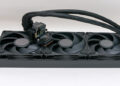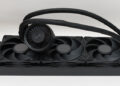

Closed loop cooling solutions are rather simple devices consisting of only a couple key components. The waterblock+pump combo that first transfers heat from your CPU’s Integrated Heat Spreader to the block’s internal fluid and then (via tubing) said “hot water” is pushed through channels in a heat exchanger “radiator” where it is cooled before being transferred back to the block to start the journey all over again. Mix in fins folded in between the water channels to increase the surface area with fans to push air quickly over said fins (and water channels)… and you have an AIO.
Simple. Efficient. Extremely difficult to do properly… when dealing with miniaturized components. After all, anyone can grab a radiator, fan, and water pump off a junked PeterBilt 589, grab an off the shelf “water block” and bodge it all together with a bunch of 1inch copper tubing to make their very own “custom” AIO closed loop cooling solution. Hell, back in the day we used our outdoor pool to temporarily cool our CPU while parts were being DHL’ed from across the pond.

So no. It’s not that hard nor complicated fabrication process. What is the bottleneck is creating a fully functional cooling solution that is small enough to fit inside a PC case. That is the fiddly-bit hard part. Fitting it inside a case and looking good while doing it? Harder still. Doing all that and not just looking good buy actually enhancing the looks, style and overall aesthetics? Even harder. Doing all that and offering top tier cooling performance? Now that is what separates the leaders from the rest of the pack.

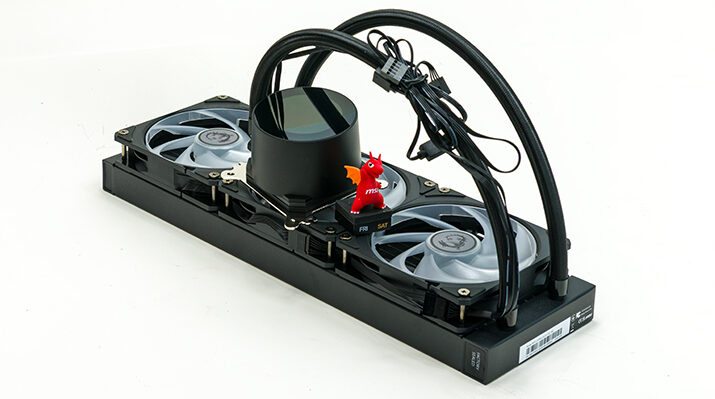
That is the standard MSI’s new P22 has to meet if it wants to keep the P13’s momentum going strong. So lets start with the most controversial feature. One that you will either consider the most important, or least. The integrated LCD screen. For open concept builds this screen is fully customizable and with a 2.1inch size (wisely enclosed in a clear, curved “gorilla glass” covering we might add) it can actually enhance the ‘wow’ factor of a build via custom graphics being displayed/played on it.

For builds that are “closed” and are not meant to showcase the internals this feature will be fall into the ‘meh’ category… until it doesn’t. After all, there is nothing stopping you from turning this screen into a troubleshooting diagnostics display. One that will show the CPU core temp, the water temp, pump speed, fan speed, motherboard temperature, video card temperature… pretty much anything you want. All you need do is program it to do so via MSI’s software.

This was true with the P13 and it is true with the P22. However, MSI obviously listened to feedback and the new and improved app that controls this hardware is extremely lightweight. Think tiny install package best counted in kilo and megabytes, not hundreds of megabytes. Think a rounding error or RAM usage… and yet with all the advanced features of the previous package. Just without the whole “MSI Center” overhead.

Color us highly impressed not only with the direction MSI is heading but the very fact that they listen and then actually implement fixes to buyer’s legitimate gripes and criticisms. All without the usual ego and “we know better than you” attitude of some other companies

Moving on. As we consider the block itself to be extremely important we will circle back to it in a moment but first the tubing. Here… nothing has changed as nothing needed to be changed. Sure we would like to see a large internal diameter tubing being used to take advantage of the increased water capacity of the ‘rad. However, it is not necessary and larger ID means a larger Outer Diameter… which in turn makes the tubing a bit more difficult to work with. Instead this nicely braided ~11.5mm OD / ~8mm ID low evaporative EPDM (Ethylene Propylene Diene Monomer) tubing is top notch for CLC AIOs. Mix in a generous length of NNN and while the tubing is important, in that MSI didn’t get anything wrong, its not as important as the two components it is connected to.

Which leads us the new and improved radiator. As All In (w)on(d)e(r) Closed Loop Cooling solutions have been around for decades (fun fact we reviewed CoolIT’s first gen products way back in the day before Asetek ran them into ground via lawfare). In that time rads have not changed all that much. In fact there is only a couple making radiators targeted at the “AIO” market niche… as most custom loop builders opt for “thick” (30+mm) rads that usually use fin stacks with mid to even high 20 folds per inch (FPI) range. Instead, “thin” (~27mm) with typically mid teen FPI range based radiators are the de-facto standard in the AIO market.

MSI however has seen the light and bucked this mediocre trend… kinda sorta. They still have not jumped into the deep end with “thick” and joined the ranks Arctic but they have bucked the anemic folds per inch trend of the AIO industry. Here we see them… dipping their toes into denser fin arrays with a 20 Folds Per Inch design. An approach which does increase static pressure and noise resonance patterns compared to the previous generation… but it is worth it. More surface area means better cooling and noise and pressure issues are fiddly bits that can be solved simply by throwing man and processing power at it until it is solved.

That however is only the first round in the P22’s mag. Backstopping this ~10 percent surface area increase is water channels which are now 25% bigger.

Since the depth of the radiator’s core is still ~20mm (as it, just like the P13 before it, has a fairly standard ~3.5mm deep “fan shroud” baked into each side) this means they are 25% wider… which means 25% increase in water capacity, a nice decrease in back /static pressure that the pump has to battle, and even a noticeable increase in the top/bottom surface area of said water channels for direct cooling from the fan. All of which means the cooling capacity of this AIO is higher, the cooling efficiency is higher, and the noise of pump is lower. All the while still being as easy to work with, and install, as any other manufactures ‘thin’ based 360-class AIO.

Put another way this is a… hybrid radiator which takes a little from column A (ease of installation and low ‘ish PC case compatibility issues) and a bit from column B (increased performance) to create something different from the bog standard AIO blueprint.

For those interested in such things, the radiator itself obviously has the same OEM/ODM as the P13- most likely KD Industrial. KDI is a company who may not be as well-known on this side of the pond… but when companies like Be Quiet! (e.g. Silent Loop 3 whose rad is pretty much a dead ringer for the P13’s rad) tap them as their ODM of choice you know they have the experience and abilities to do things right. We say all this as the “3rd” sealed ‘fill port’ location on the side of the rad pretty much screams “KDI”… especially when it is “sealed” with a Philips stamped head cap.

Before moving on. We do feel the need to point out the paint job. Unlike a lot of relative new comers MSI has spec’ed out a deep, rich and thick paint job with few if any corners cut. Instead it is well above average and while it can be scratched it is above average. Certainly not hot dipped above average but a couple layers of electrostatic spray is generally more than up to the task of shrugging off life’s dents and dings.

Which leads us the fans. With the P13 360mm edition MSI gave owners three CycloBlade 9-bladed fans. A new and fancy fan design packed with advanced features that go well above and beyond merely being ARGB equipped. Take for instance the blades’ themselves. All 9 were fused together at the end to create a focusing ring which (as the term implies) focuses all the air flow down and through the fins of the radiator. The downside was they were a… hybrid design. One where 9 blades allowed for lower noise (at a given CFM) but with less real world “torque”… as each blade was thinner. With the P22 MSI has gone back to a seven bladed design that carries over all the nifty features of the CycloBlade design… it just does it with an eye more towards real world performance rather than just paper prmoises.

Make no mistake the CycloBlade 9 on the P13 are good fans. Really good in fact. The CycloBlade 7 is just better and more capable of keeping the static pressure up high enough even at lower speeds. Making them much, much more capable of handling the beefy boi fold fin density of the P22. Put another way these fans may not be the absolute best of the best, but they are extremely good. Well past ‘good enough’ and you should try them before replacing them with your aftermarket fan of choice.

With that said… they are still rifle bearing based and their relatively mediocre 40K lifespan (A.K.A good for about 5 years of constant use… or about the same lifespan as the AIO they are attached to) is going to be their weak link. Especially when compared against ‘Industrial” or “Constant Operation” alternatives which can easily last a decade or more. So while a good step in the right direction there is still room for improvement.

Moving on and circling back to the block. To quote a famous line “The difference between ordinary and extraordinary is that little extra”. We make mention of this because while the P22’s block looks pretty much like the P13s there are differences… noticeable differences. With the P22 taking all the good from the P13 design and then making them extra.

Take for instance the “CenterFlow” design philosophy. A three dimensional design philosophy that has major real world benefits with very few tradeoffs… beyond being a lot more expensive to build. To imagine what this 3D approach looks like, think of the big block as a Hotel. The top level is the penthouse suite and is dedicated for the LCD screen and the various controllers. Below this is a level dedicated to intake of water. Water that then flows into a centrifugal pump that is then pushed down and into the bottom layer… the copper with CNC machined micro-fin cooling layer. It is then forced laterally outwards. In all directions. At the same time. Until it hits the edges and is then, and only then, routed to the edge with the outlet port (and is then pushed up the tubing and into the rad where it starts its journey all over again).

This is how the P13 did things but in the P22’s internal (nominal 0.1mm “tall”) micro-fin layout is different. Different in that the point where the water hits and is forced outwards is not the direct center. It is offset. Offset so the coldest water hits right above the hotspot on the AMD Ryzen 9000-series CPUs. Ensuring that as much heat as possible is removed as quickly and efficiently as possible.

Including an offset is not all that unsual these days… but doing it right is. Many are not bothering to spend the time and effort to do things correctly and instead upon “close enough is good enough which does negatively impact performance and user friendliness. The first part is easy to explain. By not hitting the (up to) two CCDs first the internal water is preheated by cooling the secondary chiplet… which really does not need the extra cooling. Since the water cooling the portion of the micro-fin array is not as low as it possible can be the amount of heat it can absorb from the CCD portion of the Integrated Heat Spreader is less. Which in turn means your FireBall 9000 throttles earlier and faster than it should.

The second issue is actually even more serious. By just doing a hackneyed “good enough for government work” offset the entire block can actually be set too low in the CPU socket area. This is because with AMD Ryzen 9000 series the hotspot zone is slightly “down” and towards the “front” of the chip and if the design team is not careful the block can sit so low that it can interfere with the M.2 slot and limits one’s ability to run bigboi PCIe 5.0 M.2 heatsinks… or at least if you opt for AMD over Intel. Lastly… with the copper hotplate incorrectly offset from the socket the entire of the IHS may not necessarily be covered by the micro-fin structure; rather the edges of the IHS could just be covered by “solid” copper walls running along the four edges of the waterblock.

Compare and contrast those caveats and downsides with the MSI Way. A proper offset means you needn’t worry about your new CPU cooling solution and extra tall M.2 cooler not playing nice with one another… as MSI and their MPG CoreLiquid P22 respects standards. As such you can rock basically any M.2 cooler you can think of. Also, since they properly designed the offset the entire AMD IHS is covered by micro-fin portion of the waterblock. Not just an edge of copper wall that is orders of magnitude worse at transferring heat to the water. This one-two combo makes the P22 a win-win for team Red buyers.

The downside however is you technically are further away from the hotspot on Team Blue builds. The reality… is not as cut and dry. Yes, optimizing the offset for AMD means if you install the block with the inlet/outlet ports facing the PCIe slot on a LGA1801 build just as you would on an AM5 build the block will not line up with Intel’s hotspot. However… if you rotate the orientation the AMD centric offset becomes a lot closer with the Intel Core 200/200+ series’ hotspot location. Which is how the integrated top bracket is setup to do.

Since MSI were tweak the waterblock they also tweaked the pump so as to be less noisy and less prone to harmonic resonance. In real world metrics these tweaks mean that the “thump” or “whomp” sound most AIO pumps make is minimized and there is not so much as a constant hum or thrum or whump and more a really low “woosh” or “swish” sound reminiscent of good custom water loop’s high performance pumps. Needless to say the new P22 is even more mild mannered and the noise it does make easily blends into the background / ambient noise. Equally impressive is since the water pressure resistance at the pump is lower, the pump has to work less to hit the same cooling potential. Allowing the P22’s pump to be capable of being down right silent and still effective… or conversely barely audible and yet maximize cooling (as it is a 3.4K RPM capable pump). This high / low performance combination grants the P22 an additional heaping of flexibility few other models can match.

Overall it is pretty apparent that MSI have spent a lot of time, effort, and on tweaking the P22 so that it builds upon the successes of the P13 while at the same time working to improve on the P13’s weakness. Color us highly impressed.