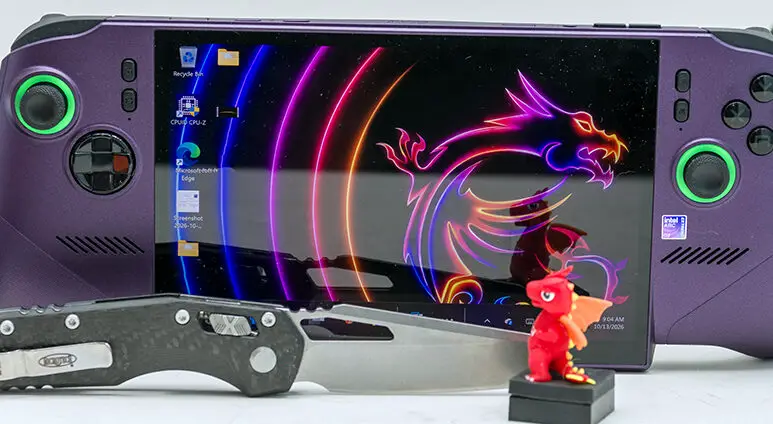

This brings us to the matter of the sheer physicality the new Claw boasts. The ‘feel,’ if you will. The decision to use a dense, structurally rigid polymer, combined with a chonky 80(ish)-Whr battery, pushes the total weight of the device up to a girthy…. substantial 785 grams. In hamburger units, that is nearly a quarter-pound (with cheese) heavier than the original Claw and noticeably heavier than a standard Steam Deck or ROG Ally. In a mediocre-designed chassis, this would be an ergonomic disaster. One where your wrists and forearms would ache just looking at it. However, because the weight distribution is surprisingly sane, and it is actually well-centered, it doesn’t feel heavy per se. Rather, it feels substantive. Especially when you grip it properly and let those new, thicker, laser-etched rear grips anchor it securely to your palms. Then it goes from being an… “absolute unit” to one that feels like the solid, premium device it is. Put another way, smart engineering transforms it from that of the average Reddit r/communism mod into a nationally ranked rugby player… albeit a nationally ranked Samoan rugby player. As it still is a relatively heavy device, just less than you would assume looking at the paper stats.

As such, one must understand that while MSI has done an excellent, standout job on the ergonomics, it is a heavy weight trying to blend in with cruiser weights. So if weight is an issue… well… there is always the kiddie-weight (and kiddie-oriented) Nintendo Switch that weighs about half of what this proper player weighs.
On the plus side, hovering just beneath the face buttons and those upgraded analog sticks is the system’s RGB array. Because Void Purple absorbs a significant amount of light (we would place its Light Reflectance Value in the mid-teens), the glowing ring accents around the joysticks do not awkwardly wash out the chassis’ color. Instead, the custom lighting contrasts beautifully with the dark backdrop, framing the control sticks with an intentional vibe that looks gorgeous without looking pretentious… especially when the ambient light is turned down, and they get to really strut their stuff.
For the time being, we are going to ignore the 8-inch screen and rather turn our attention to the internals. To be blunt, this is an extremely easy-to-shuck device. Take your time, make sure to first remove all the screws, and “shucking” it is easy – with the top and bottom halves easily coming apart.

The first thing you will notice is the battery. It’s a big boy battery with an absolute unit of a form-factor… and it alone is responsible for a good chunk of this device’s total weight. While a claimed 80Wh battery is noteworthy in the capacity department, it is not all that interesting per se. After all, recent RoGs have been rocking to the 80s, so it is not beyond the normal range seen in a handheld. No. What is interesting is the label on this battery… and as the famous saying once went, “(MSI) You got some splain’ to do”… as this TonTEK-built battery pack is not an 80Wh battery pack. It is officially a 77.8Wh rated battery pack (or about 5000mAH at its nominal rated 15.56v). Making it smaller than a legit 80Wh @ 15.56V, it should match ASUS’ battery.
To be fair, replacements for the ROG are usually only 79.72Wh (“80Wh at 15.48v”), and the entire battery industry is full of jailhouse lawyering… as the standard intentionally has a lot of wiggle room baked into it. Heck. Even ASUS themselves are wiggling the wiggle room a bit. They claim 80Wh at 15.6V, or about 5128mAh capacity. Not 5141mAh; the 80Wh would lead you to believe… and nowhere close to the nominal 5.15Ah that “80Wh” is usually rated at.

Which is fine. Everyone is doing the same thing: relying upon the “nominal” wiggle room baked into the actual standards to claim “80Wh”. MSI are just going about it from a point of optimism vs. pessimism we personally prefer. More importantly… Quid damni? As the Law of Trifles says, if there is no noticeable harm, there is no real foul. In real-world usage, you are getting 1 to 5 hours of gaming (or even more in low-power games)… and a less than 3 percent variance between expectation and reality falls well below perceivable differences. It is pretty much below the standard deviation from one battery to the next. So while disappointing to see MSI do this, it is not a deal breaker. Just be aware that MSI… rounded a corner just to match ASUS. Which is never a good thing. Do better, MSI. Do better.