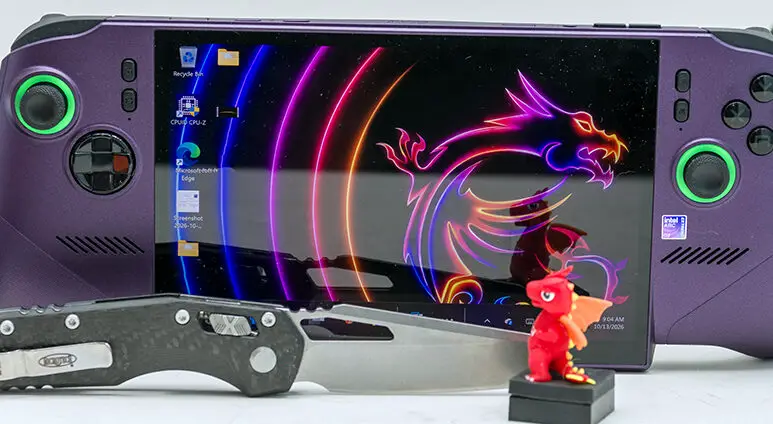

Moving on, the various color choices do segue nicely into the plastic shell itself. Unlike previous Claws (which were okay, bordering on fine in their buildout), MSI has abandoned the slick, cheap-feeling composites of the past in favor of a much more advanced shell. The front face features a premium, low-glare matte finish that resists fingerprint oils (and we assume Cheeto dust and various other detritus ‘n’ debris); while the redesigned, flared controller grips are blanketed in a sharp, laser-etched micro-texture.

This is a fantastic combination that provides a tactile, sure-grip traction that radically lowers the chances of dropping this Claw when compared to its predecessors. And that is a Good Thing™ given its price tag… as dropping anything plastic-clad may result in you having a very, very bad day.

Higher priced or not, that smartly designed shell pays further dividends the moment you wrap your fingers around the grips and actually start working with the improved layout. Not only are the buttons better laid out, but the underlying tech has been massively improved. This is because MSI listened to feedback and then radically overhauled the tactile response of the control deck to fix their malfunction.

For example… the convex, partially translucent A/B/X/Y face buttons offer a nice deep and snappy resistance with zero battle rattle. Instead of the side-actuated bumpers from earlier CLAWS, MSI wisely opted for top-actuated bumper switches in this new generation. This change reduces the… ergonomic complaints of earlier models and delivers a surprisingly uniform, almost “crispy”, feedback even if your index finger only catches the outermost edge of the button.
Below that sits a highly customized, membrane-based D-pad that sports a deeply concave, Xbox-style layout with distinctively raised axes. Which in turn provides incredibly accurate directional tracking for fighting games or retro side-scrollers… though its pronounced, sharp geometry means your thumb will definitely feel the borders during extended gameplay marathons, and if this is a 9 out of 10 on the aggression scale, maybe a 7 would be a better goal. Also noteworthy is the fact that the D-pad is not as advanced as the SteamDeck’s. On that noticeably cheaper device, you can use the DPad to de/activate the internal gyro, giving you access to an entirely different way to play. So instead of that gold standard… this DPad is like the RoG. Good. Easy to use… but dumb as a box of rocks.

This brings us to the analog inputs, where MSI finally implemented Hall Effect sensors for both the joysticks and the analog triggers. The Hall Effect triggers utilize contactless magnetic sensors that promise zero physical wear and tear over time and typically deliver noticeably reduced degradation with basically zero ‘stick drift’… right up until they die. Time will tell if this holds for the new CLAW, but what is certain is that on this CLAW they deliver a beautifully smooth, friction-free travel where the only limitation is going to be your reflexes. Which is both a good and bad thing, as you can’t blame the controller for you aging out of competitive fast-twitch hero shooters.

Sadly, going all out on the sticks and analog triggers… it makes the rest of the input architecture feel like a massive, cost-cutting compromise. Basically, while your joysticks and triggers enjoy the premium, everlasting precision of magnetic Hall sensors, the primary face buttons and D-pad are left stuck in the past, relying on traditional mechanical switches and rubber membranes that will inevitably degrade, lose their springiness, and develop dead zones over years of heavy use. For a device that MSI is positioning as an ultra-premium flagship, that is puzzling. MSI should not have stopped halfway. They absolutely should have gone all-in, engineering a completely solid-state, Hall-Effect-driven button array across the entire face (and sides) of the CLAW. Omitting magnetic sensors on the buttons you mash the most feels less like an engineering limitation and more like an accountant-driven corner-cutting on a machine where buyers are already paying a massive premium.

Thankfully, MSI didn’t let the bean counters touch the internal vibration assembly. They ripped out those weak sauce ERM rumble motors and replaced them with high-end Linear Resonant Actuator (LRA) haptic motors. Equally important is that this new tech is backstopped by a new advanced conversion engine. Which in simplistic terms means the HD haptics deliver tighter, faster, and infinitely more nuanced physical sensations. So instead of the expected unrefined, low-frequency buzz that just numbs your palms, the new array handles micro-vibrations beautifully. Allowing you to actually feel the subtle granularity of changing road surfaces under your car’s tires… or the distinct mechanical snap of an in-game reload. Bluntly stated, this combo of new hardware and better software brings this handheld’s tactile feedback closer to what you’d expect from a premium console controller. Bluntly put, until you feel and experience the difference it makes to your gaming experience, phrases like “night and day” or “generational change” do not do it justice. It is just that good and that immersion-enhancing a feature.