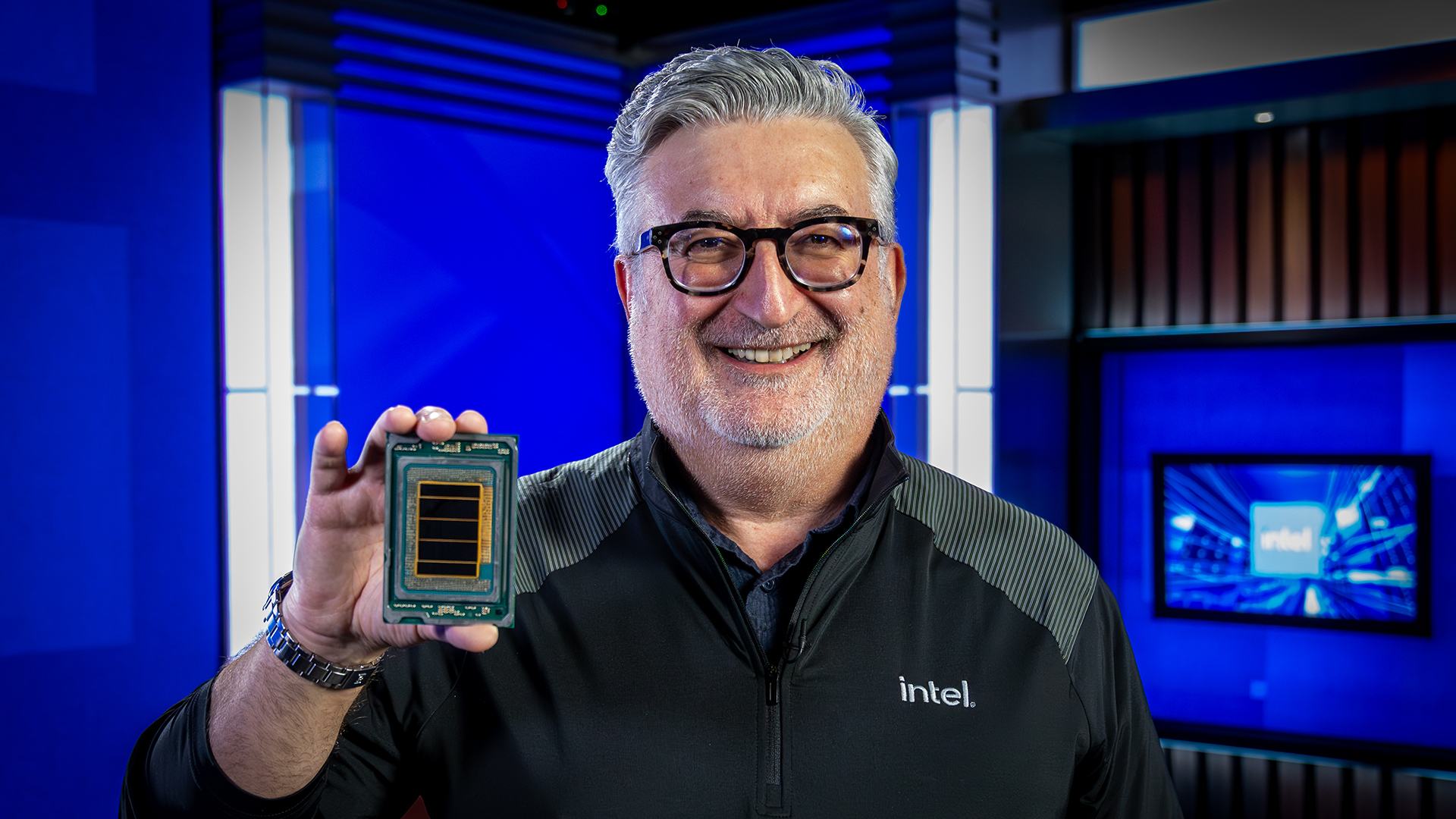
The big theme Intel is pushing at Computex 2026 is that the CPU never stopped being the centre of gravity in modern infrastructure; it just got temporarily upstaged by GPU hype. With the Xeon 6+, the company is making that argument in silicon: a data centre processor built on Intel 18A, the same process node we saw debut on the Arc G-Series handheld chips, now scaling up to server-class workloads. Paired with new networking silicon and an AI accelerator update, this is Intel’s clearest attempt yet at a coherent, top-to-bottom AI infrastructure stack.
Let’s break down each piece.
Xeon 6+: 288 Cores, Built for Agentic Workloads
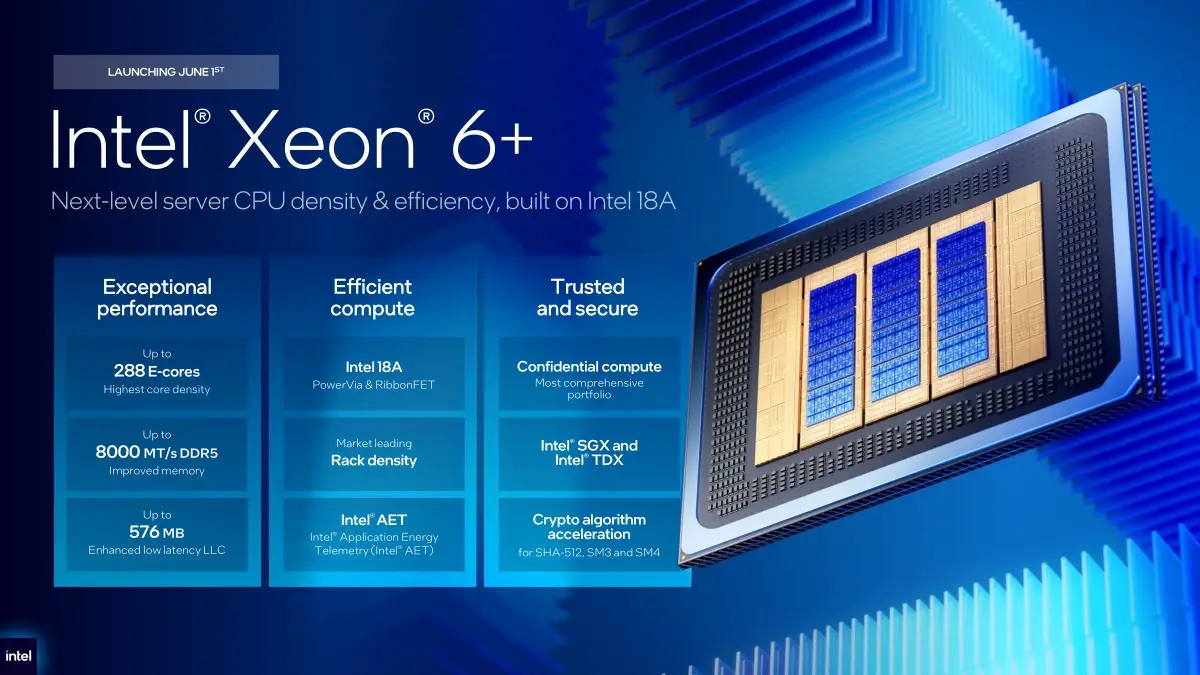
The Xeon 6+ is an extension of the existing Xeon 6 family, with the distinguishing feature being its Efficient-core focus rather than the performance-core-heavy configuration you’d find in compute-intensive HPC builds. That’s a deliberate choice: agentic AI workloads, where you have many lightweight inference tasks, orchestration overhead, and tool-calling loops running concurrently, aren’t best served by throwing raw single-thread performance at the problem. They need density, predictable latency, and sane power behaviour at scale.
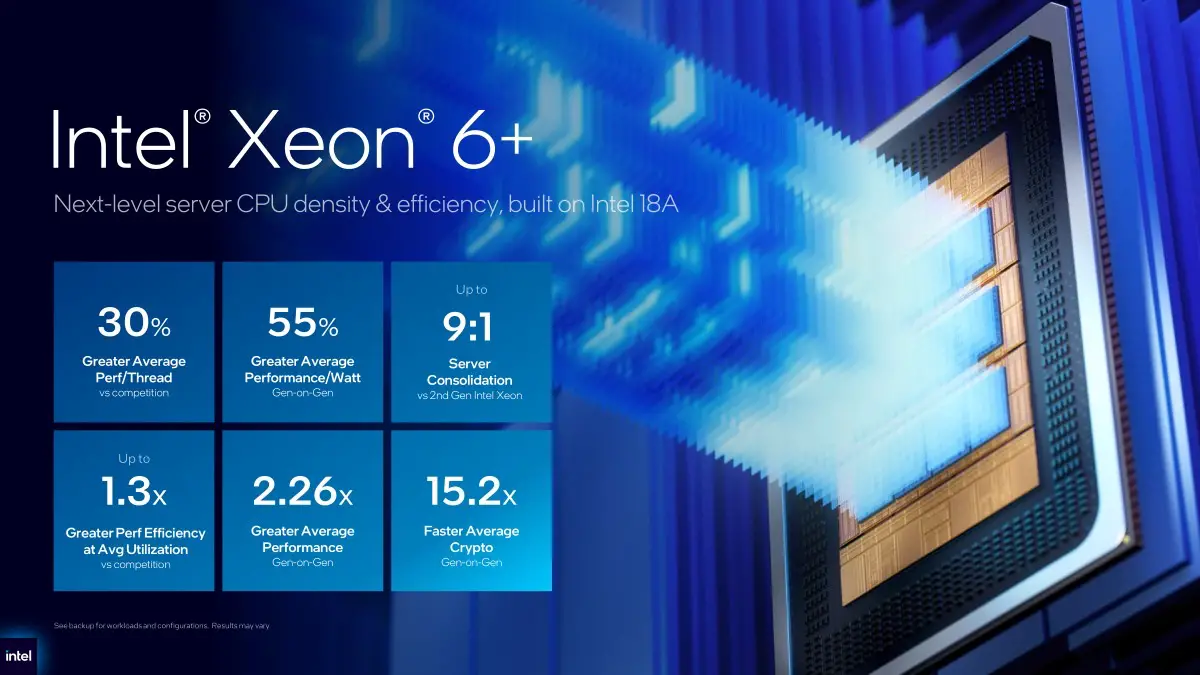
The headline numbers are 288 E-cores and up to 2.5× better performance versus the previous generation, with a claimed 45% better performance-per-thread-per-watt versus the competitive landscape. Intel hasn’t published the full comparison methodology publicly yet, standard disclaimer, but the consolidation story is the number that will land with operators: up to 9:1 server consolidation versus 2nd Gen Xeon means you’re potentially shrinking rack footprint significantly, which has real power and cooling implications at scale.
The Intel Application Energy Telemetry (AET) addition is quietly interesting. Real-time workload-level energy telemetry built into silicon means operators can actually see what a specific agent pipeline is costing them in watts, not just track aggregate server draw. As AI workloads become more dynamic and multi-tenant, that kind of granularity matters for cost allocation and capacity planning.
Security coverage is comprehensive on paper: Intel SGX and Intel TDX for confidential computing and multi-tenant isolation, which is table stakes for any cloud provider deploying shared agentic AI infrastructure.
OEM ecosystem coverage at launch is solid; Dell, HPE, Lenovo, Supermicro, GIGABYTE, ASUS, and Ericsson are all confirmed. The telecom angle with Ericsson is worth noting; network infrastructure is one of the most demanding environments for sustained, low-latency concurrent processing, which is precisely where the E-core density argument is strongest.
Ethernet E835: 200GbE With a Power Efficiency Play
The second major announcement is the Ethernet E835 controller and adapter family, which scales to 200GbE and supports port configurations from 2×25GbE all the way up to 1×200GbE. That flexibility matters because not every deployment needs full 200G, having the same silicon family span the range simplifies driver stacks and qualification overhead for system integrators.
The efficiency claim is the headline Intel is leading with here: the E835-CQDA2 adapter delivers up to 1.9× higher performance-per-watt than NVIDIA’s ConnectX-6 DX, and 1.4× better than Broadcom’s BCM957508. Intel’s comparison methodology is noted in the small print and worth scrutinising, but if those numbers hold under independent testing, it’s a meaningful differentiation in environments where 400+ NICs per rack are common, and networking power draw adds up fast.
RoCEv2/iWARP RDMA support and Dynamic Device Personalization for packet processing offload are standard expectations at this price point, so no surprises there. The 10+ year lifecycle commitment will resonate with telcos and enterprise buyers who can’t afford to re-qualify networking silicon every two years.
Crescent Island: The GPU Intel Needs to Compete
The Crescent Island disclosure is more of a preview than a launch, but the details are interesting. Built on the Xe3P architecture, the high-end variant of Battlemage, Crescent Island is positioned specifically for inference workloads in agentic AI pipelines: long-context, token-intensive tasks where memory capacity is the binding constraint, not raw FLOPs.
The memory spec is the standout: LPDDR5x up to 480GB. For context, NVIDIA’s H200 ships with 141GB HBM3e. Crescent Island is clearly not trying to compete on memory bandwidth, LPDDR5x is lower bandwidth than HBM, but rather on total capacity and total cost of ownership for inference-heavy deployments where you need large model contexts in memory simultaneously. It’s a different trade-off, and one that makes more sense for orchestration layers than for training or dense matrix operations.
The 350W air-cooled PCIe form factor is a practical win for deployments that don’t want to retrofit liquid cooling infrastructure. And the data type coverage, native FP4/MXFP4 through FP64, with microscaling format support, puts it in line with what modern quantised model deployment requires.
Intel’s pitch on software compatibility is the Arc Pro Series as a developer ramp: build and validate on available desktop hardware, deploy on Crescent Island with forward/backward compatibility across the Xe install base. It’s a reasonable strategy, and the open software stack angle is a direct shot at NVIDIA’s CUDA lock-in, though that’s a battle Intel has been losing for years and will need sustained execution to shift.
The Bigger Picture
What Intel is really arguing with all three of these announcements is a systems-level thesis: GPU clusters are great for training, but the boring, unglamorous work of running production agentic AI, routing requests, managing tool calls, handling concurrency, moving data between storage tiers and accelerators, lives on the CPU and the network fabric. If that thesis is right, Xeon 6+ and the E835 are well-positioned. If the AI workload mix continues to favour dense GPU compute even at inference time, Intel’s data centre business stays in a difficult spot.
The 18A manufacturing angle deserves a mention here too. This is the first data centre CPU on Intel’s most advanced process, and it’s fabricated domestically. For hyperscale and government customers with supply chain concerns, that’s a procurement argument that didn’t exist two years ago.
One more item quietly buried in the release: the Xeon 6300 series now gets a 12-core drop-in option for entry servers, raising the ceiling for SMB platforms without a platform change. It’s a minor footnote compared to the rest of today’s announcements, but it’s the kind of incremental ecosystem move that quietly expands Intel’s addressable market at the low end.