
The next change to the Compute Tile is the fact that the AI, the NPU, and the integrated memory controller now all reside in this honking big hunk of sand. But we are not complaining. Not in the least. If you are going all in on Big Compute, Tiles might as well “Go Big, or Go Home” big.

For example, baking in the tiny 1.8nm node and going Texas Big means it allowed Intel the luxury of giving the 3-series an NPU that is actually capable of handling real-world AI demands. Bluntly stated the last gen “NPU 4″ may have been rated for ‘up to’ 48 TOPS int8 (aka ” Tera Operations Per Second using 8-bit integer precision”) but it’s six NPCs would quickly thermally limit, and in scenarios longer than “Hey Cortana…”, it acted more like a NPU with less than half of its rated TOPS. Much better than the previous generation, but not good enough for the AI Vision that Intel has for personal computing.

With NPU 5, Intel has opted for three larger NCEs with double-sized MAC arrays instead of the six smaller NCEs found in NPU 4. While this does sound like a downgrade, the NPU 5 array is not only rated for “up to” 50 TOPS but is rated for 50 continuous INT8 TOPS. This means that Corta… err… SpyPil… ummm… Copilot+ can now operate almost entirely locally without offloading to the cloud unless you ask a question that requires an internet search. For business users who disable that lil’ snoop “helper,” this means Live Captions, Studio Effects, and Recall search are almost entirely local and live. It also means 4K rendering assistance can consistently happen.

It means a laptop can use the camera to perv… err… can monitor if you are still at the system or have walked away so as to reduce the screen’s power consumption and totally not spy on employees or rat you out to “AI Big Brother” (patent pending and “pay no attention to that man behind the curtain”). More importantly, it can do all that while creating 20% to 30% less DRAM traffic compared to the NPU 4 generation. All of this underlies the “consistency is key” philosophy at work in the new 3-series.
The 3-series also gets a better Integrated Memory Controller. While it is still only dual-channel, it can now natively handle LPDDR5x-9600 frequencies, which allows for about 13%(ish) higher real-world bandwidth compared to the previous generation (technically 153 vs. 136 GB/s, but in reality, it is more like 130 vs. 112 GB/s). Mix in the fact that the controller is right there on the Compute Tile and does not have to push data over the ring bus just to feed the P/E/LP cores, and this is a great one-two combo. It is so good that it is not just a Good Thing; it too is a Great Thing™.
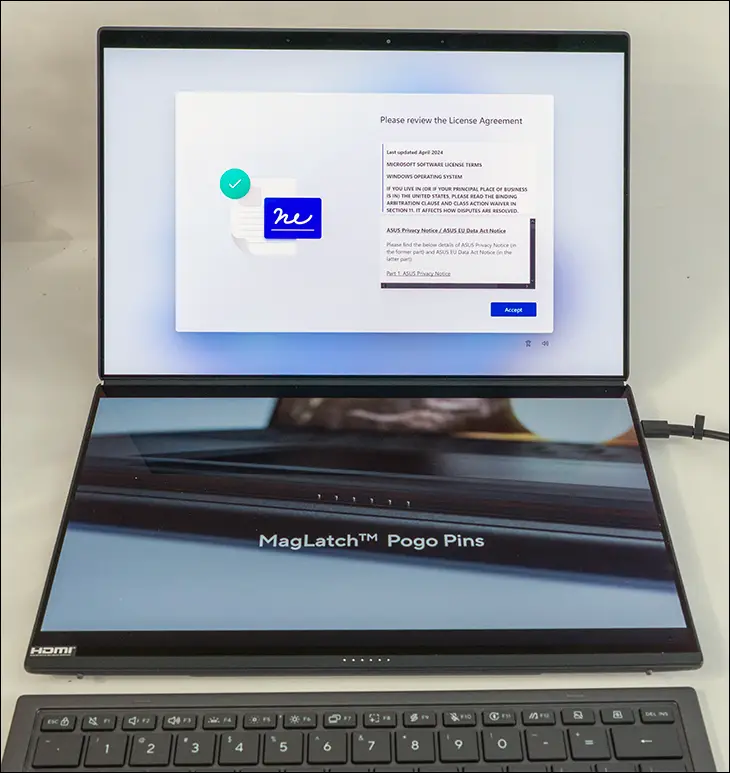
This is especially true since the Compute Tile has to share its off-die (aka RAM) memory with the iGPU, as shader starvation is a real concern. Arguably, this is critically important on dual-screen devices. On Panther Lake devices using soldered memory modules, you cannot just swap in larger sticks to increase the “VRAM” buffer size. Instead, the CPU has to “ThunderDome” the two competing priorities in real time when the “dying time” comes around… and it always comes around when talking about only 32GB of RAM handling both Windows 11 bloated overhead and VRAM duties.