
This brings us to the other issue with this laptop. Lack of DIMMS. Yes. Most ultra-portables are just as guilty of doing this as Asus. Yes. Asus is just copying the “innovation” of Apple. The “everyone does it defense” holds little water with us… and post-Wizard of Woz Apple should only ever be used as an example of what not to do. Soldering the DDR5 ICs directly on the board here in non-cult land should be an auto-DQ offense by the sane majority of buyers. Somehow, though, people still buy soldered RAM laptops. Worse still they are offering ‘flagship’ models with only 32GB on the PCB. On a laptop that needs at least 8GB (and preferably 16GB) for the iGPU. On a laptop that is also running the very definition of “bloatware”: Windows 11. That… that is a devastating triple low-blow combo that should not be allowed to exist in 2026. Instead, give us DIMMS so we can yeet the tiny 16GB sticks and put in appropriately sized RAM sticks without having to break out a soldering iron; or at least give us 64GB as the base model for the flagship 388H versions! Asus did neither. Given the price increases when going up from 32GB models, this smacks of e-waste and corporate greed. Be better, Asus. Be. Better.
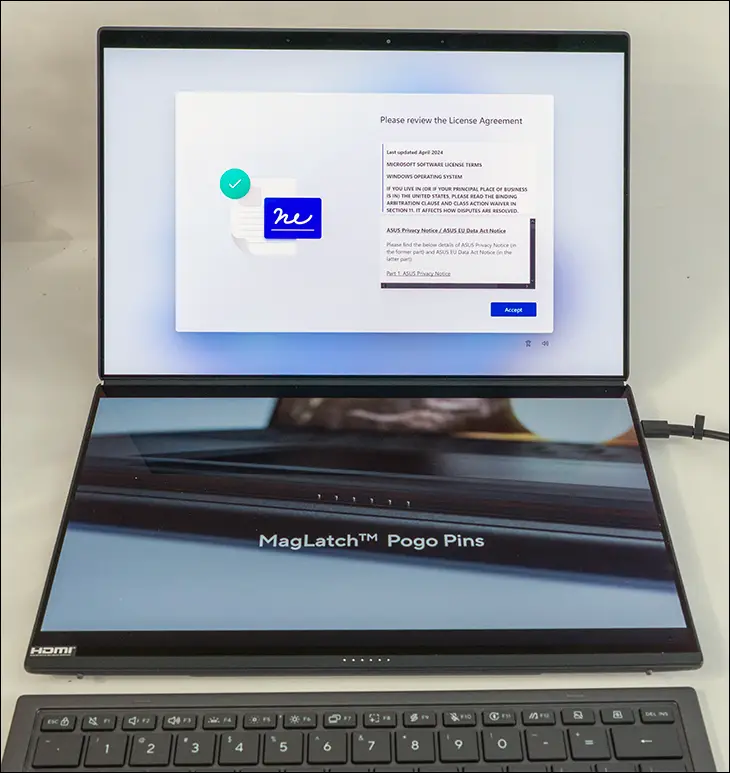
On the positive side, the included Windows 11 image still allows for offline account creation via a simple trick that Microsoft engineers surely loathe. At the WiFi screen, simply hold Shift + F10. Then, in the CLI pop-up window, type:
start ms-cxh:localonly
During installation, do not choose the USA or Canada. Choose International English (and select Ireland as your country) so that less spyware is installed and more of it can be disabled. After installation, run Win11Debloat or our personal choice, Chris Titus Tech winUtil, to clean things up.
If that sounds like a hassle, and since plenty of influencers are making bank recommending Linux, we will just say this: given that this is an Intel Arc iGPU-based system with specific custom software requirements, we would not recommend a “Penguin replacement” at this time.
Moving on, and adding to the positive side tally: this laptop may be rocking a Core Ultra 9 388H with customizable TDP profiles, but that does not mean you need to resort to Silent Mode to get a real-world quiet experience.
In Standard Mode (PL1 at 42W), the fan acoustics vary from dead-silent to a gentle whisper. Even in Performance Mode (PL1 at 55W), where the system ramps up for extended heavy lifting, it remains remarkably civil. This is quite the feat considering “ultra-portable” is usually marketing shorthand for “too hot for your lap” or “too loud for a boardroom.” Instead, this machine is perfect for a university auditorium or a late-night work session without waking the house.

Also impressive are the included speakers. Once again, this is typically an area ultraportable models cut corners on. Asus has not… this time. Last gen? It was decent for its class. This time, they not only (once again) give you a 1/8th-inch TRS (aka “3.5mm stereo”) port that does double duty as an external mic hookup or external stereo speaker hookup, but they also include six rather good (for the ultraportable class) speakers. We are not fond lovers of the… “Harmon Kardon Experience,” but the four dual-diaphragm woofers provide decently low bass, reasonably clear mids, and the two front-firing tweeters (hidden near the hinge mechanism) are pretty darn decent for handling the highs. Sure, we would have liked to see it go to an 6 or even 10 component 3-way configuration with 2 tweeters dedicated for the highs, 2 to 4 mid-ranger drivers, and 2 to 4 woofers for the bass… but for what it has to work with, the response rate is rather good and rather enjoyable for a 2-way based speaker system.

Some of this is because, in the default configuration, the system is using six distinct speaker components to create a virtual Left and Right speaker(1+2 config on the left and 1+2 on the right)… but a lot has to do with the fact that it is using multiple opAMPs. To be precise, it is using a Cirrus Logic CS35L56+CS42L43 topology that is part of Cirrus Logic’s SoundWire PC Audio Solutions…and Asus calls their “Smart Amp Technology”. This is the exact same hardware that the 2024 was rocking; however, by going from 2 speakers to 6 in a virtual 2 speaker configuration, the codec has more room to work with… resulting in audio that is noticeably better than the last gen. Color us impressed.
Moving on. The integrated webcam is… adequate and does not get the same upgrade treatment as the speaker sub-system. Instead, you basically get the same 1080p30 FHD sensor with the same lens as found on the 2024 model. However, thanks to Intel and their IPU 7.5 processor features baked into the Core Ultra 3-series… the end result is superior to the 2024 model. Better auto-framing. Better eye correction and noticeably better background segmentation over the UX8406 baseline capabilities. All of which means the same hardware yields more professional results. Now just imagine what IPU 7.5 can do if given an actually good (by 2026 standards) webcam to work with!?