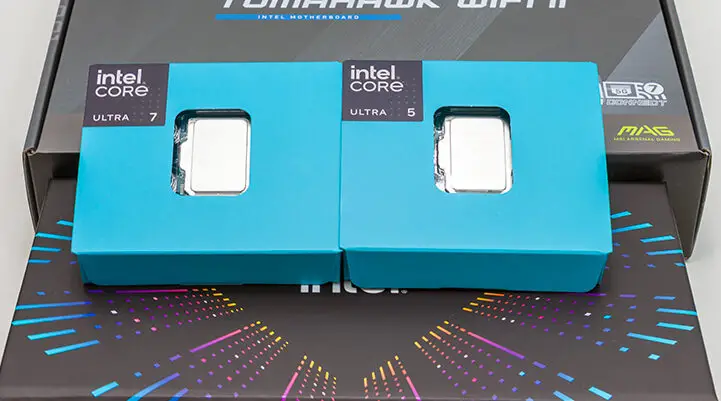

While highly interesting, with major potential for causing future paragons shifts in the industry… I-BOT software does not really raise to the level of warranting new hardware model. In fact, certain fanbois will probably argue that the Plus was released solely so that “old” Core Ultra 200 models won’t get the love and attention they deserve. Forcing recent Intel buyers to upgrade sooner than they expected to. That would be overly harsh as the software is the desert. Not the main course. Bluntly stated, these two Plus CPUs redefine what a 7-class and 5-class CPU should be and should offer. Forget caveats like ‘Intel 7/5’ we mean all 7 and 5 branded CPUs. Including AMD Ryzen 7 and Ryzen 5. When thinking about these two CPUs phrases such as “night and day differences”, “clean break from the past”, “boundary breaking” and a whole host of others readily spring to mind.

This major shift in tone and temp is because Intel craves a return to the days of being seen not only as a viable alternative to AMD but the (to literally quote Intel Reps) “The Shinning Beacon on the Hill”. One where AMD go back to being the ‘value alternative’. Which is very doable. Hard, but doable as Intel has stepped up their game. To be perfectly blunt if they had not fumbled so badly the whole Intel DEIing… err “Intel CPU DIEing earlier than they should due to internal hiring practices mistakes” the (non-Plus) Core Ultra 200 would have righted their ship and got them back on track. Sadly, that debacle did happen and past Intel enthusiasts did harshly judge the Core 200 series. With many who feel “burned” by Intel taking a multi-generational wait and see approach before even thinking about a new Team Blue CPU.Which is usually, a catastrophic Extinction Level Event for most companies. So how did Intel go about making sure it wasn’t an “ELE” for them? They did it by not being greedy and making a 9-class Plus option. Instead they designed the 9-class and 7-class option and then branded them as Class 7 and Class 5 Plus models.
Kinda-sorta. Only if one is being overly pessimistic… which most will be. As ClownWorld does what ClownWorld does best: rage bait.

The truth of the matter is the amount of refinement Intel could quickly bake into the Core Ultra 200 Plus architecture is limited. Without doing a full rebuild, and at this point in its lifecycle that would have been a non-starter, the underlying architectural “blueprint” simply does not have that much wiggle room in it… as it was intended to be a Tock generation. One designed to be replaced with entirely new Tick series tech in the next generation to help avoid even a whiff of past “tick+++” mistakes. As such a “Core Ultra 9 290K Plus” with very little to distinguish it from the 285K would have undermined everything they were trying to achieve with this new Tick/Plus/Tick/Plus cycle. Namely. 1) Provide as much performance as possible throughout a generation’s entire life cycle. 2) Provide four (or more) CPU product cycles per socket instead of two (hopefully). To make their 7-class beat the ever living holy hell out of AMD’s 7-class option and finally 3) to entirely, completely, own the 5-class corner of the market… where most of the money is made.

That is why the “7-class” Core Ultra 7 270K Plus will be seen as a tweaked “9-class” Core Ultra 9 285K and the “5-class” Core Ultra 5 250K Plus well be seen as a highly tweaked “7-class” Core Ultra 7 265K “with two P-Cores chopped off”. You should not. These new Plus CPUs are using entirely new Compute Tiles and entirely new SoC Tiles. That is why, if you ask, Intel readily admits that while the older 285/265/245K have not technically been EOL’ed… these two CPUs replace those three non-Plus CPUs. It just is not a bad thing, or a desperate thing, or anything like that. It is a calculated change in direction for Intel’s product development cycle. One with far reaching implications.

So what has changed at the architectural level? A lot. Most of which Intel refuses to give specifics on. However, a lot is known via the specifications of said CPUs and a lot more can be inferred from what Intel says and does not say about them.
First up what is 100 percent known to have and have not changed.
The P0/1/2/3 levels of Cache amount has not changed. The general layout of the P and E-Cores is not radically different. The names, the duties, the total count and even overall layout of the various Tiles has not radically changed. Nor has the core arch’ of the E and P cores changed enough to warrant an entirely new name for them. Instead they are still Lion Cove and Skymont. The Tiles themselves however are new. Baked in the same ‘ovens’ (Compute being N3B, GPU being N5P, SoC in N6), but different from the non-Plus versions. So any fears over “pick and pluck’ Compute Tiles from 285K’s working their way on to 270K Plus / 265K in 250’s are unwarranted. Same with the SoC. Intel has reworked these Tiles so much that they are different.

So what can be interfered? Since everything is known to be running faster, latency of the higher levels of cache must be lower… as this latency is mostly impacted by the bus they run on, and the DDR5 memory attached to the other end of said bus (now up to 7200+ instead of 6400+). Basically filling the cache “off die” will be faster and missed cache calls will be faster to be rectified… as the CPU will be waiting few cycles for the data to cross the length of the bus. All of which means higher IPC in the real world. More importantly since I-BOT is not backwards compatible the low level algorithms must have been modified. Most likely significantly. Most certainly with new options and hooks that did not exist in the in pre-Plus world… as Intel specifically said that when explaining why I-BOT was not backwards compatible.

That… that is a very, very big deal. Quickly being able to bake in new algorithms with new options is a potential performance game changer for how Intel creates, tests, and implements their low level logic-trees/algorithms/AI code. We say that as it is these new algorithmic tweaks that are mainly responsible for the I-BOT improvements in already Intel optimized games. Sure an extra percent or two of overall performance does not sound like much… but that is actually significant. Both Intel and AMD spend massive amounts of resources on researching ways to improve IPC and Intel’s hardware level software mathletes just handed an older arch tangible real world improvements even when handicapped by increase software overheat (remember I-Bot is not “free” and does take up processor cycles to run its magic). Thus the real low-level improvements are even larger than what I-Bot infers… and they will carry forward to the Core Ultra 300 series. In fact, they can be further tweaked based on real world (and lab) testing of the Cure Ultra 200 Plus CPUs. Meaning Intel just got a whole lot more agile with the ability to quickly modify, implement, and then test their algorithms (and ‘AI’ logic-trees) in the real world. Which is the kind of engineering agility that Intel’s Tick/Tock product lifecycle was intended to create in the first palce… and yet had not been seen in Intel since the inception of Intel big.Little.
Needless to say, Intel’s Plus series is impressive for not only what it offers consumers now but what it promises to offer in the future. To which we say… it is about damn time. Team Blue needed to pull off a successful MoonShot to get back in the good graces of the average buyer. Time will tell how forgiving buyers will be, but Intel is certainly in a lot better position to ask and be granted forgiveness than before. Put another way, and to bodge ‘n’ butcher two famous quotes, Intel’s engineering team just wrestled the laurel of conquest from the very jaws of defeat… but now it is up to management to keep it. Let’s hope they can as the marketplace needs all the coemption it can get.