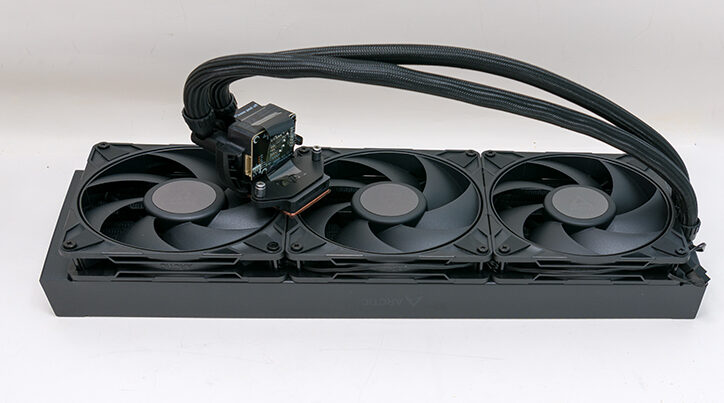

Moving on to the other improvements baked into the Pro. As with the previously reviewed 420 version, one of the main claims to fame of the Pro series is the fans. The ALF 3 came with extremely decent “P12” fans. The P12s helped build Arctic’s reputation as they are the epitome of “good enough”. So “good enough” that few would bother with purchasing, say, Noctua Industrial series fans to gain access to even more static pressure. The new P12 Pro fans? They are almost a match for NF-F12 industrialPPC-3000 PWM fans. Let that sink in. A free fan that can almost match a fan that typically costs 30 to 40 Canuck Bucks.

To be precise, these new P12 Pros offer 6.9mm of static pressure and offer a very reasonable (for a high static pressure 120mm fan) ~77 CMM. That is a recipe that all but guarantees excellence when attached to a thick boi (~38mm) radiator. Put another way, these P12 Pros are sure to become cult classics, and we consider them to be just as good, and even arguably better, as their P14 Pro brethren. Color us impressed… now if they will only make a Constant Operation version that is rocking Japanese Dual Ball Bearings, and we will no longer need to ever consider Noctua PPCs for the majority of ‘constant operation’ scenarios.

Of course… not everything is perfect with these new bad boy fans. TANSAFL is always in effect… as There Ain’t No Such Thing As a Free Lunch. At the end of the day, Arctic has optimized these fans to the Nth degree and made the entire AIO industry look antiquated… but to hit that beefy static pressure, one has to be willing to push the fan to a blistering 3K. At 3000RPM, they are noticeable. Not as noticeable as many 3,000RPM fans (especially Noc’ey PPC3K’s), but still noticeably louder than the last generation. Thankfully, you do not have to run them at 12V to net an improved static pressure over their predecessor. In apples-to-apples comparisons, they are an across-the-board improvement over the previous design. So much so, you can easily run these down at 1200-1500rpm at still get a lot of cooling ability. In fact, it is not until about 2200 to 2300RPM that they start becoming really noticeable… but they quickly ramp up from that above this point. As such, with better high-end and lower-end, we do consider them much more flexible than the already excellent (and… pardon the pun… fan favorite) P12s that the non-Pro ALF 3 were rocking.

Before moving on, we do have to point out one neat little addition that one may not even notice. Arctic has actually baked in a proper wiring channel to the sides of the frame (of both the P12 and P14 Pro series)! Yes, now you can jam this AIO right up to the side of a case and not worry about vibrations slowly eating through the fan cabling. Furthermore, the cleanness and ease of use are also further improved. Once again, this is a small tweak, but one that just shows the level of commitment to their customers that Arctic has. Highly, highly impressive.
Also firmly in the win column is the cabling for said fans (and the pump) is now a proper gauge (24AWG instead of 26AWG). While we doubt many will notice… 24AWG can handle six of these fans. Due to the higher amperage demand of the P12 Pros (up from a piddly ~0.1A to ~0.33A) it is still a wee bit too near the edge of our comfort range’s tolerance, but it is now firmly on this side of that line.

While we cannot prove it, the block itself is also slightly tweaked. Yes, the form-factor is precisely the same. Yes, nothing else is blatantly different… but the internals appear to be different. Be it from slight tweaking to the impeller pump design, slight changes to the micro-fin array, or just from different OEMs being used for said parts, this new block is quieter and more capable than the non-Pro. Not enough to warrant purchasing the Pro variant all on its own, but even small gains quickly add up when it comes time to choose.

The other change that many may not notice is the tubing. No, we don’t mean the length. Yes the 360 gets 450mm length tubing compared to the 500mm of the 420. Yes, that technically means you get about 10mm more slack in said tubes compared to beefy boi 420 – as the inlet/outlet ports on the 3x120mm rad are 60mm closer to the installed block than on the 3×140 rad. That really doesn’t matter all that much. Keep in mind the minimum bend radius (or simply use a sensibly sized case), anda 0.40-inch difference really doesn’t matter.
What does matter is that the tubing is now officially better. Arguably the best in the AIO market, and one has to go the soft tubing route in a custom loop to find its equal. This is because it is not solid, thin-walled tubing. Instead it is rocking ~3mm thick walls (~12OD, ~6mmID). Walls that have been reinforced. Much like a car tire, this EPDM tubing is ‘belted’ with a centrally located fiber reinforcement (likely nylon with aramid being a dark horse possibility), which reinforces the tubing and dramatically decreases the chances of a blowout. While it is true these sealed AIOs are not running at 30+PSI like a tire, there is pressure from the water being forced through them.

Furthermore, this reinforcement ensures that bend fatigue does not occur (as easily or quickly). Basically, in some cases you really have to sharply bend the AIOs tubes to route them around internals. In other cases (especially when the rad is top-mounted), the sheer weight of the tubing hanging down causes internal stress fracturing at the ‘barbs’ on the inlet/outlet ports. These stressors, combined with the somewhere in the range of ~0.5 to 2PSI of water pressure, have killed a few AIOs (and systems) over the years. Especially around year 5 when things start to show their age. Put another way… end users don’t even know about minimum bend radius standards, let alone follow them. Thus, Arctic does it for you.

For those interested in reducing stressors as much as possible, it goes without saying that ‘gentle’ bends are good, and 90-degree bends are verboten (“be obtuse… not a cutey”). However, beyond that common sense level standard, with “standard” EDPM (i.e. is not fiber reinforced), one should adhere to an 8 to 12 times the ID bend radius rule of thumb, and for confirmed reinforced EDPM, you can drop that down to 4 to 6 X. In other words most AIOs should not have a bend radius smaller than 48mm (really 72mm to be safe); but with the new PRO ALF 3 series you can get away with it just being above 24mm (with 36mm being a better minimum).