Intel is expanding its enthusiast desktop lineup with the new Intel Core Ultra 7 270K Plus and Intel Core Ultra 5 250K Plus, two processors designed to push gaming and content-creation performance further while keeping compatibility with existing platforms.
The chips are part of the Intel Core Ultra 200S Plus series, an updated version of Intel’s current desktop CPU family. The company is positioning the new models as both faster gaming processors and stronger multithreaded performers thanks to more cores, faster interconnect speeds, and a new software-level optimization feature aimed at improving performance in certain games.
More cores and higher interconnect speeds
The biggest hardware change in the new processors is the addition of more efficiency cores.
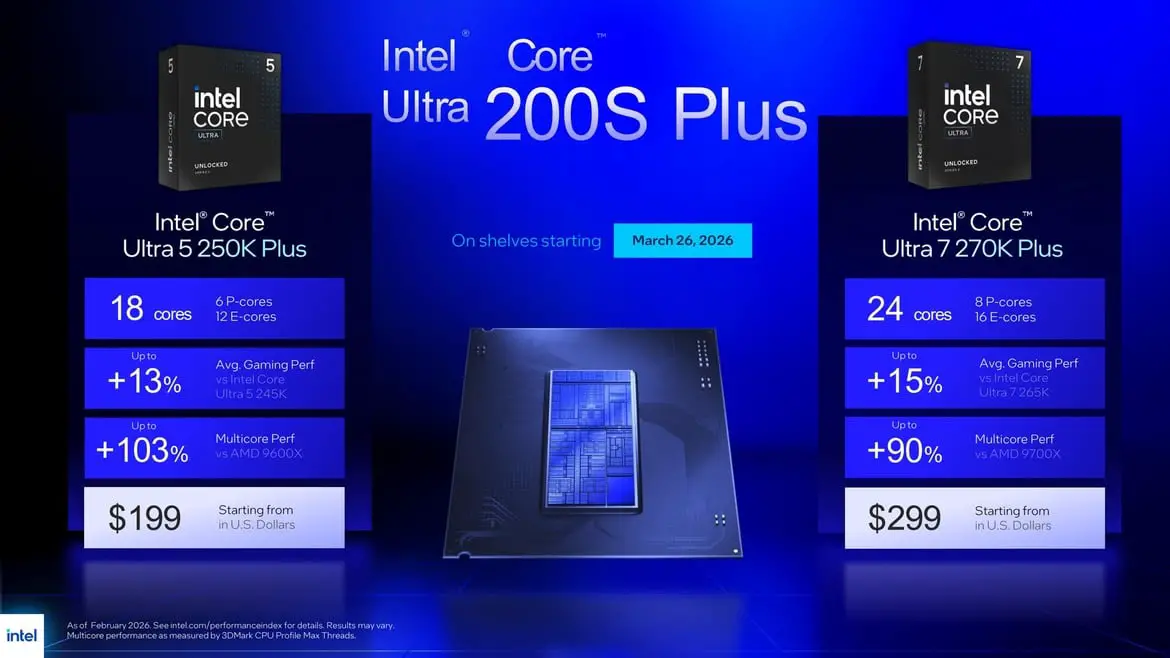
The Core Ultra 7 270K Plus now features 24 cores in total, consisting of 8 performance cores and 16 efficiency cores. Meanwhile, the Core Ultra 5 250K Plus increases its configuration to 18 cores, with 6 performance cores and 12 efficiency cores.
Beyond the extra cores, Intel also increased the die-to-die interconnect frequency by as much as 900 MHz compared with the previous models. This link connects the CPU compute tiles and memory controller, and higher speeds should reduce latency and improve responsiveness in games and other real-time workloads.
According to Intel’s internal testing, the result is up to 15% higher average gaming performance compared with earlier Core Ultra Series 2 desktop processors, along with significant gains in heavily threaded workloads.
A new tool designed to improve game performance
Alongside the hardware changes, Intel is introducing a new piece of software called the Intel Binary Optimization Tool.
The feature works as a binary translation and optimization layer, allowing the processor to improve how it executes workloads, even if the application or game wasn’t originally optimized for Intel’s latest architecture.
Intel says the technology draws on decades of performance-optimization experience and can boost instructions per cycle (IPC) in certain scenarios. In practical terms, the company claims it can improve performance in select titles without requiring developers to update their code.
If widely supported, this could become an interesting new lever for Intel to improve performance in older games or titles optimized for competing architectures.
Faster memory support and emerging RAM technologies
Memory support is also getting an upgrade with the new CPUs.
The Core Ultra 200S Plus processors officially support DDR5-7200 memory, an increase from the DDR5-6400 limit on earlier 200S chips. Intel is also continuing its enthusiast-focused approach to memory tuning with support for the 200S Boost BIOS profile, which enables DDR5-8000 overclocking with warranty coverage.
Another notable addition is early support for 4-Rank CUDIMM memory modules, a new type of DIMM that can offer significantly larger capacities.
These modules are expected to support up to 128GB per stick, bringing workstation-class memory capacity to mainstream enthusiast systems. Support will depend on certain motherboards built around Intel’s 800-series chipsets.
Platform compatibility remains unchanged
One key detail for existing builders is that the new processors retain compatibility with current 800-series chipset motherboards.
That means users already running an 800-series platform may be able to upgrade to the new CPUs with only a BIOS update, rather than replacing their entire motherboard.
At the same time, motherboard vendors are expected to release new 800-series models throughout 2026, including boards designed to support the upcoming high-capacity CUDIMM memory modules.
Pricing and availability
Intel says the new processors will begin shipping through retail partners on March 26, 2026, alongside systems from OEMs and system integrators.
Suggested starting prices are:
$299 for the Core Ultra 7 270K Plus
$199 for the Core Ultra 5 250K Plus
With more cores, faster memory support and a new software optimization approach, the Core Ultra 200S Plus series represents Intel’s latest attempt to push performance further in the enthusiast desktop segment—particularly in gaming and heavily threaded workloads.