
Arguably, one of the main claims to fame of the new Pro series is going to be the stock fans. Make no mistake, the original ALF 3 came with very good fans. (More than) Good enough fans that few bothered with purchasing say Noctua Industrial series fans to gain access to even more static pressure. That… that is not something we can say about many 1/2/3×140 mm-based “stock” AIO fans.
Are the new “P14 Pro” fans compared to the originals? They smoke them and damn near any fan you care to mention. In fact, they pretty much make the “San Ace Sacrifices” (noise, cost, increase dimensions… did we mention noise) no longer a wise trade-off. Think 5.2mm of static pressure moving (up to) 110CFM of air. Or to put all this another way, if the last gen ALF 3 5-bladed fans were say an ICE-based pony car from the 90s, these new P14 Pros fans are a modern EV-based Lotus. One that offers excellent “horsepower” (aka 110 Cubic Feet per Minute of air movement) and nearly unparalleled levels of ”torque” (aka an insane 5.2 mm of static pressure).

When one then includes the baked-in DaisyChain abilities… well… forget limiting terms such as “best AIO stock fans” and start thinking in terms of this new 7-bladed design being some of the best fans available today. Period. So much so that if Arctic does what Arctic has in the past, and swaps out the Fluid Dynamic Bearing for a Japanese Dual Ball Bearing foundation while not noticeably increasing the price… whelp… Noctua will be hosed.

Of course, not everything is perfect with these new bad boy fans, and there is no such thing as a free lunch. At the end of the day, Arctic has optimized these fans to the Nth degree and made the entire AIO industry look antiquated… but… in order to hit that beefy static pressure and CFM statistic, one has to be willing to push the fan to 2.5K. Bluntly stated at a nominal 2500RPM, they are noticeable. Not as noticeable as many fast-moving 140mm fans, but noticeably louder than the last generation. Thankful,y you do not have to run them at 12v to net improved static pressure and air movement. In fact, in apples-to-apples comparisons, they are better than the previous design across the entire operating envelope. So much so,o you can easily run these down at 1500rpm at still get a lot of cooling ability.

This wide operating range means we would consider these P14 Pro fans to have the equivalent of a 6th overdrive gear when compared to the previous P14 fan series. One where if you really, really need to cool things down fast, they will power up and cool like few fans can, but for the majority of their lives, they are going to be living in the 1000 to 1800RPM range. A surprisingly wide range that will net you darn near silent to actually silent cooling. All without compromising performance all that much. Color us impressed.
Moving on.

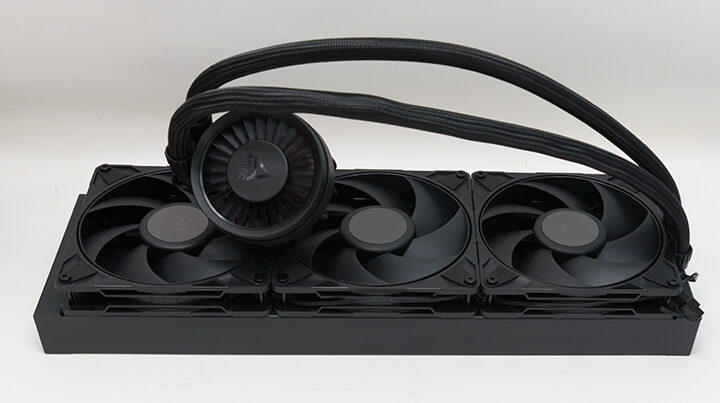
For those who have never handled, let alone worked with, a “420” class AI, we thought we would include a picture. After all, a “picture says a thousand wor, ds” and in this case, some of them are going to be curse words. Especially if you look closely and realize that this AIO is bigger than the box the already beefy ALF 3 Pro 360 edition comes in. Yes. It is literally as wide as that box. Yes. It is literally ~4.5cm longer than that box. Ye, that’s why we call it an absolute unit… as it is Big. Beefy. Boi.

The upside to this is if you are seriously thinking about a 420-class AIO (and to be blunt, this is the only 420 you should be thinking about), you can simply take your existing 360’s box and hold it in position to get a ‘feel’ for how honking long and wide the 420 really is. Thus, if the box won’t fit, this AIO probably won’t either, and you are gonna have to get a bigger boat… err… case.

One of the biggest claims to fame the ALF series has always had is the VRM cooling fan baked into its waterblock. With the ALF 2, it was a small centrifugal blower (aka ‘squirrel cage’). It was better than nothing, as did kept many an overheating VRM (especially on LGA2011ss) from overheating. It was, however, loud and really did not move all that much air. The ALF 3 swapped that out for a Big Arsed Axial Fan (trademark pending). One that moves a ton of air, and yet does not need to run at mega-RPMs to do so.
So has anything changed, or been improved, with the Pro series? No. The ALF 3 Pro’s axial fan is exactly the same as the non-Pro. Right down to the ‘Rev 1.0’ on the PCB. Furthermore, Arctic has not improved the coverage and allowed this beef boi to cool M.2 heatsinks along with the VRM. To be blunt, this is because the covering for said fan has the exact same design as the exact same “shadow”. Yes, that shadow is on the block inlet/outlet side… but plastic can be molded. They could have added an air channel to… bend some of that airflow around and towards the M.2 slot. They did not, and thus the largest negative of the ALF 3 design is still in full effect: NVMe M.2 cooling compromises(… on some CPU sockets).
On the positive side… at least your DDR5 RAM will get a bit of air flow. Yeah. Yippee. Hyperbole aside, this is an issue, but at the same time is a nitpick. Most AIOs don’t do VRM cooling. Cooling that the motherboard manufacturer’s design team still assumes is going to be there. As such, the ALF 3 is still class-leading. It just is not perfect and needs a redesign. Either in this fascia covering’s air flow… or in mounting orientation limitations. Either works for us. Either must be enacted in a future design.

Counteracting this issue is actually a little tweak we are glad to see here. That is that the bloccable is now 24AWG. Not the fire hazard, 26AW, G, the non-Pro was rocking. While we doubt many will notice… 24AWG can handle six of these fans. Due to the higher amperage demand of the P14 Pros (up from a piddly .17A to .35A), it is still near the edge of our comfort range, but it is firmly on this side of that line. Not the other, like the non-profit is. Color us impressed!

Beyond that, the above issues are nearly all of the … with the only other one being the lack of options in mounting orientation. With the ALF 3 Pro talking the Henry “any color as long as it’s black” Ford approach to options, you get one. Sure, including two orientations for the inlet/outlet tubing would have necessitated a major overhaul… but this is a Pro-branded model and not even giving professionals a secondary option (even if it is just South/North instead of North/South and not E/W) is frustrating. Put bluntly, these three issues are self-inflicted wounds. Ones that we would expect from rookies. Not seasoned veterans like Arctic.

Moving on before our blood pressure gets the best of us. Also firmly in the ‘same’ category is the paint job. Here we have zero complaints. Yes, we would love to see the ALFs come in Candy Apple Red, SeaFoam Blue, Hunter Green… but at the end of the day, 99.9 percent of builds are fully covered by deep, dark, rich black and pure white goodness. Mix in the fact that this is some thick and scratch-resistant paint, and we doubt many will have any complaints with the ALF 3 Pro series on the aesthetics front. Put another way, the ALF 3 Pro looks like a much more expensive A, IO, and that is a good thing.
In between these extremes of “same” and “different” categories is the block itself. First, the obvious. The form-factor has not changed… at all. The internals appear to be slightly refined. Most likely due to improvements in manufacturing (e.g, a bit of tweaking to the micro fin array, pump blade angle, etc., etc.) or simply a change of source manufacturer for some of the components. No matter the root cause, this block is both more efficient and quieter. Even when run flat out, the noise characteristics are slightly improved, and it is even easier to ignore the ‘hum’ than on the already rather good ALF 3. Color us impressed.

Also, neither fish nor fowl (but certainly good red meat) is the tubing. How much has changed? Probably not too much. What has changed is that Arctic is finally making it clear that these are not like most AIO’s tubing, and instead, they take a page from custom “soft” loops tubing. Namely, they are not “solid” EPDM/neoprene/etc. Tubing and rather are more like a car tire and are ‘belted’ with a centrally located fiber reinforcement (likely nylon with aramid being a dark horse possibility) that reinforces the tubing and dramatically decreases the chances of a blowout. While it is true these sealed AIOs are not running at 30+PSI like a tire, there is pressure from the water being forced through them.

Furthermore, this reinforcement ensures that bend fatigue does not occur (as easily or quickly). Basically, in some cases, you really have to sharply bend the AIOs tubes to route them around internals. In other cases (especially when the rad is top-mounted), the sheer weight of the tubing hanging down causes internal stress fracturing at the ‘barbs’ on the inlet/outlet ports. These stressors, combined with the somewhere in the range of ~0.5 to 2PSI of water pressure, have killed a few AIOs (and systems) over the years. Especially around year 5 when things start to show their age. Put another way… end users don’t even know about minimum bend radius standards, let alone follow them. Thu, the Arctic does it for you.

For those interested in reducing stressors as much as possible, let it go without saying that ‘gentle’ bends are good, and 90-degree bends are verboten (“be obtuse… not a cutey”). However, beyond that common sense level standard, with “standard” EDPM (i.e. is not fiber reinforced), one should adhere to an 8 to 12 times the ID bend radius rule of thumb, and for confirmed reinforced EDP, M, you can drop that down to 4 to 6 X. In other wor, most AIOs should not have a bend radius smaller than 48mm (really 72mm to be safe); but with the new PRO ALF 3 series, you can get away with it just being above 24mm (with 36mm being a better minimum).

If all that sounds like Swahili…. a 355ml (12oz in freedom units) aluminum can of (the typical) adult beverage has about a 33mm bend radius. So if you stick a (unopened/empty) can of adult beverage up to the bend on the ALF III Pro, and it is tighter than the bend on the can… It’s too tight a bend. If it is about the same or slacker than a wide-mouth mason jar, it’s above 45mm bend radius, and you should be GTG (almost) regardless of the material used for said tubing.

Once again, these kinds of ‘fiddly bits’ that can kill a build (in the long term) have been thought of and proactively ‘fixed’ by Arctic just underscore the type of commitment to long-term customer satisfaction that is one of the big reasons why we consider them, and their 3rd gen ALF, class leaders. One that we wish more companies (like Asetek) would follow. Needless to say, we like the direction the Arctic ALF 3 team is going and can see a lot of potential in this new revision. Now… let’s install this beast and see what else has changed.