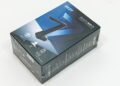
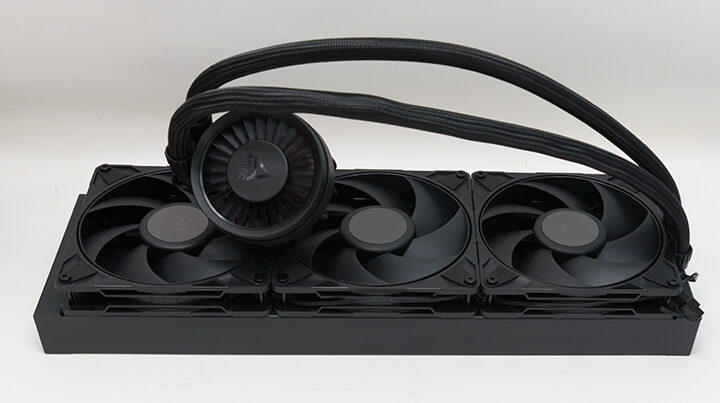

For those who have never seen, let alone handled, a 3x140mm “420” sealed closed loop cooling solution, the ALF 3 Pro 420 (as we are going to call it for brevity’s sake) is going to stand out. This Pyramid of Power just grabs your attention and keeps it, unlike any standard AIO shipping container. So much so that with just a quick glance, Ye Olde Monkey Brain’s curiosity center will become fully engaged, and just like Curious George, you will need to go in for a closer look. At which point all the information will then sell you on why you want a 420… and question why you never even considered them in the past. That to us is pretty much the epitome of the GOAT level of marketing.

Make no mistake, this iconic shipping container did not come about via some Apple-esque philosophy. It came about from practicality. Namely, trying to minimize the overall footprint of these beasts… and the simplest way to minimize the X and Y axis footprint is to increase the Z-axis.

To do this, Arctic’s team… thought outside the box and instead of the rad sitting “flat” (like they do in 99.999999 percent in other AIO boxes), it is actually tilted upwards inside said box. The end result of this is that when two ALF 420s are cleverly stacked on top of each other, the overall dimensions really are not that much more than a pair of stacked ALF 360s.

This, in turn, allows Arctic to ship a pallet load of these cheaper (per unit) than most 420s. Which in turn keeps the MSRP down. This, in turn, allows you, the buyer, to buy a 3x140mm AIO for only a few bucks more than many of the little 2x120mm options cost.

Of course, this happy accident is not all sunshine and lollipops. An angled rad is not as stable as one that is sitting flat, and it will want to slip and slide around inside the box if given the chance. Which is why the ALF 420s have notorious levels of overkill internal protection. As they have to… but it is hard to argue with results, as this is a 420 AIO box that will shrug off copious amounts of blunt and sharp/shaped force trauma. One simply has to get used to the idea of storing a Big Arse’d Box™ for the full six years of their warranty.
Moving on to the included accessories.

On the one hand, not much has changed with the list of accessories. Same (controversial) lack of included installation instructions, with buyers expected to scan a QR code and get access to premium animated instructions. The same lack of a torque wrench that will keep you from nuking your Intel CPU socket. The same great TIM, but none pre-applied to the ‘block. Three good fans. A whole passel of cable options. Same great, if lacking in backwards compatibility, Intel and AMD installation hardware.

Yes. On the surface, this is a disappointing list of accessories for a so-called Pro model. The reality is that first impressions can be wrong, and the ALF 3 Pro series is a great example of this. This is because once you get beyond surface-level impressions… a lot of changes and tweaks have been made. In many ways, these low-key improvements are a great analogy for the entirety of the ALF 3 Pro generation. Let’s start with the hardware installation parts included in the box. Yes. The same AMD and Intel socket support is all that you get. So using any ALF 3 on any Intel CPU before the 12th generation is a non-starter. Yes. That means any system before Alder Lake in 2021 is a non-starter, and one must look elsewhere for proper backwards Intel compatibility. That… is a short window of compatibility.

Thankfully, it supports AMD’s old AM4 and new AM5 socket form-factor… so even ancient AMD systems can use this AIO. Furthermore, we have to begrudgingly have to agree with Arctic’s choice to snub older Intel users. This is because Arctic does not rely upon the stock Chinesium contact frame and instead includes one of the best replacement Intel contact frames going. So good that, even if you could, you would not want to go 3rd party. So good, you will be mighty pissed if you plunked the cost of those 3rd party options, as this one is just as good. Arguably better than most as it is now optimized for LGA1851 with the integrated “offset” now moved North so as to cover the new compute “tiles” location on the silicon.

Sadly, it is all those things, but it is also extremely finicky when it comes to installation. Intel never designed the ILM to be an end-user replaceable component, and as such comes with a very narrow torque range of 0.9Nm to 1.13Nm. Which,h unless you are extremely experienced will not be able to freehand once… let alone hit for times in a row.
This is once again a pet peeve of ours, as a cheap plastic ‘click’ torque tool should come standard with any device that requires you to yeet the bog standard Intel contract frame and use their proprietary one. Thankfully, you can pick up a cheap torque meter/wrench… or even an electric torque ‘wrench’ for only a couple bucks. It will get you into the right ballpark without costing you all that much, and keep Mr. Murphy from inviting themselves to your build party.

On the positive side, all system builders should be using a digital torque device and not relying upon ham-handed screwdrivers when it comes time to mount any CPU cooling solution. Also on the positive side is it appears Arctic has improved (or at least seemingly tweaked) the spring ‘bow’ built into the waterblock. Though with such a small sample size, we are hesitant to say it is definitely improved… but it was easier to work with than with the original ALF 3. As such, while still not what we would classify as user-friendly, it is apparently a bit easier to work with.

One last thing we should care to mention on the accessories. Arctic is technically including MX6 in with the ALF 3 Pro series, but as they have recently released a MX-7 successor… at some point, your box will probably come with it. To be blunt, if MX6 were all we had to use, we would not be unhappy with the situation. At all. It’s good, TIM. We just prefer to either opt for older MX4 which is eons easier to work with (more liquidly vs the MX6’s pasty consistency) or diamond based TIM (which is eons better than any non-conductive paste)… or use a HoneyWell pad (as we are lazy and pads are easier for scenarios where something is being installed, and uninstalled on a semi-regular basis). This new MX7 appears to take all the performance improvements baked into MX6 but with a consistency closer to MX4. In testing, it was noticeably easier to spread than MX6 and yet performed a smidgen better. Once again, we would not rush out and buy a 4-gram tube of it to use with an ALF 3… but we would use it over the MX6 if we had it on hand. Food for thought, at the very least, when it comes time to restock your TIM supply.