
These days, PCIe features, such as M.2, are major selling features for any premium‑priced motherboard – and that goes double for “premium but practical” options. However, AMD did not upgrade the total lanes nor pretty much anything else when they recycled the dual P21 configuration for the “enthusiast” X870E (dual) chipset. Make no mistake, the X870E is basically just a (firmware) “refined” variant of the X680E (and its dual P21 chips). That leaves manufacturers in a rather precarious position. On the one hand, the seemingly infinite maw that is modern‑day storage requirements demands more and more and more. On the other… said lanes of storage bandwidth have to come from somewhere. Especially when AMD mandated USB 4.0 be included, not the “optional” or “nice‑to‑have‑on‑certain‑models” feature it was when the P21 was designed. Yes. The “X870E” is showing its age, and while MSI (and others) are doing their best to make a silk purse out of a sow’s ear, “bifurcation” is the word of the day in Team Red land.
Yes, that “bifurcation.” That four‑letter word has a lot more than four letters in it. The bane of professionals and designers… and one of the biggest reasons to opt for Threadripper (if AMD ever gets around to refreshing it, that is). What this is and does is simple. It cuts up the few PCIe lanes AMD offers in such a way as to allow buyers to use as many of them at the same time as they can. Every motherboard design team will prioritize things differently, but one thing remains constant: TANSTAAFL is always in full effect. There Ain’t No Such Thing As A Free Lunch.

To begin, PCI_E1 (aka the top‑most PCIe 5.0) slot, the PCI_E2 (“middle” PCIe 5.0) slot, the M.2_2 (aka the second PCIe 5.0 slot directly below the top‑most M.2 slot), and the bottom PCIe x4 slot all share the same 24 bandwidth lanes. If the “math is not mathing” for you, don’t worry – this is pretty typical by X870E standards.

So first of all, the top two PCIe x16 slots share x16. This can either be in a x16/0 configuration, a 0/x16 configuration, or a x8/x8. You cannot get x12/x4 or x4/12. However, you can use all three PCIe slots at the same time, or you can use the top two plus the M.2, but you cannot use all four options at the same time in a x4/4/4 + M.2 in x4 mode. Instead, it becomes 8/8/2 +2 (for the M.2), which is fine. An AMD GPU and an Intel BattleMage need to be in x16 mode to get the most out of them. Hell, an NVIDIA RTX 5090 in x8 mode results in single‑digit performance differences compared to it being in x16… but you will see a major performance impact in x4 mode on most mid‑ to high‑end GPUs. Sometimes, even some wonky stability issues can be tracked back to using the “wrong” PCIe slot on the “wrong” motherboard.

As such, we think that the MSI Ace Max set is above average. Not perfect. Not without controversy… but certainly above average. More options are always better than fewer, unless they create problems. Then more options just mean more problems. With that said, some may disagree. So this is how the ProArt and Dark Hero do it, so you can decide for yourself: ProArt offers 3 PCIe slots, but only four M.2 drives, and the bottom‑most PCIe x4 slot’s bandwidth goes through the chipset. Meaning latency penalties are significant, but you don’t have to worry too much about random wonkiness or port‑disabling tomfoolery. The Dark Hero is similar but noticeably more complicated than the ProArt. First, the bottom PCIe x4 slot is fed from the chipset, not the CPU, but the top PCIe x16 slot drops to x8 mode the moment you use an M.2 drive in either M.2_2 or M.2_3. Even if the middle “x16” slot is not populated. Even if it’s only one GPU plus one PCIe 4.0 M. shortcode drive installed in the “wrong” M.2 port. Your video card is going to run in x8 mode if you are not careful about which M.2 ports you populate. Worse still, if you populate both M.2_2 and M.2_3, your middle “x16” slot is disabled. If that sounds like a headache, you’re right. Thus our opinion on the MSI Ace Max being above average, with as much pragmatic practicality baked in as possible.

Moving on. The layout of the PCIe slots is fairly decent by modern standards. Since M.2_1 is the main PCIe 5.0 slot, it, of course, is located as close as possible to the CPU in order to help reduce latency and EMI/EFI‑induced errors. This, however, means the “top” x16 PCIe slot is moved down one full slot. On its own, not a big deal. However, this has cascading consequences for the rest of the slot layout. Namely, MSI could only space the two “x16” slots out by 3 slots if they wanted to include that tertiary “x4” slot. Not 4. These days it is not uncommon to see 3.25, 3.5, or even 4‑slot monsters as the world has gone insane. Thus, you have to be very, very careful with what GPU you purchase for the primary PCIe slot.

You also have to be careful, as the spacing between the secondary and tertiary slots means the secondary PCIe slot is limited to 2‑slot devices (or less). Any more and you don’t get that tasty PCIe 5.0 x4 slot. Make no mistake, it is a massive selling feature. Typical boards that include a “x4” tertiary slot have it connected to the chipset, meaning it is a PCIe 4.0 x4 slot. Not PCIe 5.0. This difference is not subtle and makes it a highly valuable real‑estate… and one of the few times where M.2‑to‑PCIe adapters arguably make more sense than using the “fifth” M.2 slot. Especially if you come across a big‑boi M.2 22110 PCIe 5.0 drive and want to get all the performance that the kidney you sold got you, as the only 22110‑er on this board is limited to PCIe 4.0 x4. Food for thought, and once again, this kind of flexibility with really no “wrong” answers is why the Ace Max is “Ace” in our books.
With that said, there are a couple of quirks with the M.2 we have not gone over. First is that none of them are compatible with SATA M.2 drives. Which is not a bad thing. Get a SATA‑cable‑to‑M.2 adapter and plug in the cable and power adapter into your hooptie M.2 and stop wasting a precious M.2 port on it. Next, while it is indeed true that all four of these M.2 ports get both top and bottom cooling baked in, it is quirky. If you own an M.2 2260 or M.2 2280, all will work. If you own an M.2 22110, it’s limited to being used in the M.2_3 slot and thus PCIe 4.0 x4 capped. Also, none of these ports offer M.2 2232 nor even M.2 2240 compatibility. Few will care, but if you are one of the few that do, you will have to either yeet the screwed‑in bottom heatsink and live with only one‑sided cooling, or get a cheap‑o (or print) a 32/40‑to‑60/80 adapter. Neither is a great option.

Lastly, that selfsame chunk(s) of alloy that allow dual‑sided M.2 cooling will have to be adapted if your high‑performance M.2 comes with its own high‑performance heatsink, and if it doesn’t, you probably will want to pick one up. We say this as the top PCIe M.2 slot may come with a cool‑looking heatsink that is perfectly adequate for most PCIe 4.0 x4 drives, but that is not the same as saying it is optimal, nor is it even tolerable for high‑performance (think 10+ watts of TDP) PCIe 5.0 x4 drives. This is because MSI refuses to update their heatsink to include a heatpipe, a cooling fin, or, even better still… both. Bluntly stated, the Dark Hero’s “smokes” this ~3oz heat spreader.

On the positive side, all four M.2 ports not only get the dual‑sided‑heatsink‑based “M.2 Shield Frozr Technology,” but they also all get the latest variant of MSI’s “EZ M.2 Clip” tech. This securing mechanism does a marvelous job of keeping the M.2 drive secure and makes installation/removal a breeze. Push it backwards, push the M.2 board down, gently let go… and your M.2 drive is secured. No screwdrivers. No plastic clips to fail. Just easy, peasy, lemon‑squeezy goodness. This is a marked improvement over the last‑gen Ace Max and even sets it apart from the Carbon WiFi, both of which included at least one EZ Latch Gen 1 port.
Counteracting this improvement is the fact that Asus’ layout is typically superior with a “back‑to‑front” configuration for at least some of their M.2 ports. One where the unlocking mechanism is nearest the front of the motherboard, not near the rear of the case / “back‑of‑the‑board unlocking” that MSI is using. While it may not sound like much of a difference, it is when the motherboard is installed in some cases, and big‑boi air coolers are used. In these scenarios, not having to grab a long screwdriver to push on a “hidden” latch in order to avoid having to yank the GPU just for an M.2 drive replacement is a big deal. MSI needs to update its layout to keep up with the competition if they are truly serious about practicality in this premium corner of the marketplace.

This “good, but could be better” opinion carries over to the heat spreaders. We are not going to beat the dead horse on the top‑most one, but the middle “big” heatspreader is both better and yet still not better enough for PCIe 5.0 10watt drives. It is not rocking a screw‑less EZ removal mechanism, but the latching posts are now on the motherboard and not the heatsink. So all you have to do is push in the metal button and then gently lift up to remove the 3‑way (6oz) heatsink, or the button for the single M.2 (3oz) heatsink. To reinstall, simply line up the big posts on the bottom of the 3‑way, or the small one on top of the top‑most M.2, slide the sink into place, and then push down. When you hear the click… It’s secure.
Don’t get it twisted. This is eons easier than it used to be. It just needs to be flipped so that the release mechanism is towards the middle of the case, as our big‑ham‑hands find it difficult to actuate the hidden release mechanism when it’s so close to the back of the case. We personally have gotten to the point where our personal policy and procedures is to use a plastic spudger to reach down and release it rather than a finger, and never a screwdriver, which can easily slip and scratch the top layer of the motherboard’s PCB. Compare and contrast that to if it were nearest the SATA‑ports end of the motherboard, where one has oodles and oodles of room to work with, and you can see why we are of the opinion that there is room for improvement. Much room for improvement.

Moving on to SATA. Given the sheer number of features included, it should come as no surprise that MSI went with their bog‑standard 2×2 SATA port configuration. Just like they did on the previous gen of the Ace Max. Four SATA ports is sadly pretty much the de facto standard these days, and both the ProArt and Dark Hero are no better in this regard. Bluntly stated, if you need more than four, you probably are going to want to invest in a good HBA and use that CPU‑connected PCIe x4 slot for something good. Otherwise, the state of the entire marketplace will annoy you to no end.
On the positive side, MSI has upped the front‑panel USB count nicely and made good use of the area that “should” contain two extra dual‑SATA‑block headers. For example, the last‑gen X670E Ace Max had two USB 3.0 (“5G”) ports via a single “double” USB front‑panel header. This version comes with two of them, both of them also being that sweet, sweet 90‑degree style for a clean final‑build look. As this is X870E‑based, you also get a Type‑C port. Which is decent. Not perfect, but decent. On the one hand, it is 60‑watt PD compliant and thus your case’s front Type‑C port can pretty much charge darn near any (normal) portable device you can think of. It can also, in a pinch, properly power the typical USB docking station. The only issue is simple: there is only one of them. Many professionally‑oriented cases come with two Type‑C ports. Meaning you may need to use that tertiary PCIe x4 slot for a USB 4.0 adapter, which wouldn’t be a bad idea, as this Type‑C header is not USB 4.0 “40G” compliant. It is a USB 20G. Put bluntly, an Ace Max‑class motherboard that prides itself on premium practicality needs a second Type‑C front‑panel header at the very least. That is what Asus offers on their Dark Hero, and that is the standard MSI should strive to meet and even exceed.
Yes. That would mean moving the EZ Con / JAF_2 header somewhere else, as the typical location for said second Type‑C header is where they placed it. Yes. Most would feel that is the practical solution, especially if that special header was moved to the rear area to cover off the lack of rear 4‑pin fan‑header issue we previously pointed out. Thus, while a good improvement for the Ace Max design, there is still room for improvement.

Moving on. Running along the bottom of the motherboard is a good assortment of headers. In typical MSI fashion, the front‑panel header cluster is neatly positioned for easy access. Of course, they could have stuck it anywhere, and we would not complain, as this board has been given the “EZ Front Panel Cable” treatment. This cable makes it so you can plug in all your case’s cables to this adapter and then simply plug it into the motherboard.

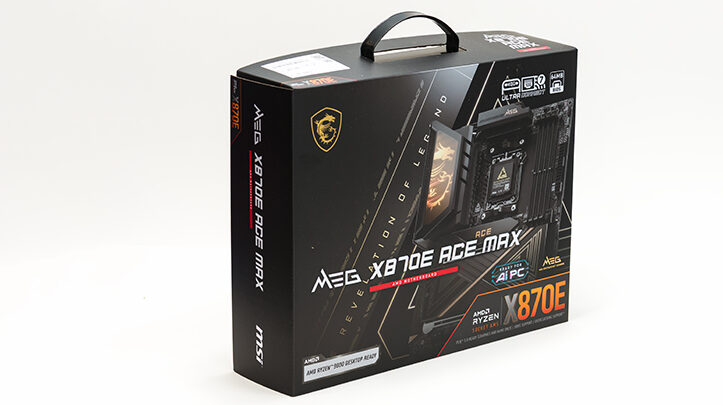
For those who have never used it before, we cannot stress how big a deal this is. It alone makes the MSI MEG X870E Ace Max way, way more user‑friendly than even the RoG Dark Hero. Tight case? No problem! Big case but short cables? No problem, as it inherently extends the cable length! Good case, but it’s pitch‑black down in the corner? No problem, it’s keyed so it cannot be installed “wrong”! We cannot stress how novice‑friendly this cable adapter is and how it neatly sidesteps many a pitfall that first‑time builders run into when they think they are in the home stretch.

Furthermore, MSI has also broken the front‑fan‑header section into two separate and distinct clusters that are not even remotely close to one another. Specifically, the Power, Reset, HDD, and Power LED headers (AKA JFP1) are in their usual bottom‑right‑corner location, but the 4‑pins for the speaker are not.

They are up and away from JFP1, and it is labeled JFP2 in the manual. Sadly, MSI still has not standardized the location of this header. So with this specific board, the easiest way to find it is to look at the big Power and Reset button cluster, then look up past the dual DIP‑switch cluster, and right above them is JFP2 nestled near the 3‑way M.2 heatspreader. So while it is a wee bit difficult to find, it is one that makes things easier.

Before we move on, we need to explain that dual DIP‑switch cluster, as these are mighty fine features. The first is a BIOS switch. Yes. That does indeed mean this beastly board comes with dual BIOS ROMs. Meaning you typically will not have to resort to the BIOS “Flashback” feature. Instead, flick it to the alternate setting, reboot, and you are up and running. Fully recovered from a bad BIOS update and/or your own Fat‑Finger Moment. That is really nice to see, and places the Ace Max head and shoulders above both the cheaper ProArt and the more expensive Dark Hero. Basically, the Dark Hero team went with one big 64MB BIOS chip and were too cheap to include two of them, whereas MSI was able to squeeze everything into one 32MB and carried that saving over to including two of them. Once again, highlighting the differences in key demographics they are targeting: “overclocking enthusiast” vs. “premium practicality for professionals.”
Not to undersell the other DIP switch, but it is one that you will either love or not even know it exists. That is because it is a physical on/off switch for all the onboard RGB LEDs. Yes. With just a flick of your fingernail, you can turn all the LEDs off and create a truly “blacked‑out build.” Yes, we are biased, but we do love having this nifty feature included, as relying upon software to disable all the LEDs is a bit of a PITA and more prone to random gremlin overrides.

Lastly, we come to the soundcard portion of the motherboard. Hidden underneath the 1.1oz “heatsink” that does double duty as an EMI shield-ish is a very, very good Realtek ALC4082 HD audio codec paired with an ESS ES9219Q ‘Sabre’ combo DAC and headphone amplifier (DAC/HPA). This actually is the same combination that the Dark Hero uses. Albeit with a few tweaks that technically make it superior to the baseline version, MSI is using.

To be a wee bit more precise, the Asus SupremeFX version has been tweaked (e.g., Savitech amp, making full use of the four channels baked into the ESS9219, etc.) so that it is not just amazing for headphones, but also offers better audio precision with passive speaker configurations. Though not night and day differences, these low-level tweaks can matter.

Some will notice the wider soundstage and prefer the ‘color’ of the audio output from the Dark Hero to the Ace Max. Others will notice if they routinely swap from using headphones plugged into the front panel of your computer and speakers plugged into the back. Here the MSI version can get a bit confused from the large variance in impedance and cause one sound to be ‘quieter’ than it should… or conversely, randomly spike too much voltage to one or the other.

To be blunt, all of that is technically true. The reality is, the only people who will argue over the ASUS configuration being ‘vastly’ superior are people who have invested a lot of money into their audio equipment. Ironically, meaning the very people least likely to use onboard audio as they have a PCIe or USB-based external DAC that handles all the heavy lifting.

Once again, it all boils down to paper boosting specs vs practicality… as the Dark Hero configuration does add to the MSRP. Many will argue needlessly as the MSI Ace Max is so superior to typical options that it is the very definition of ‘good enough’ that may just save you the cost of buying a USB DAC.